
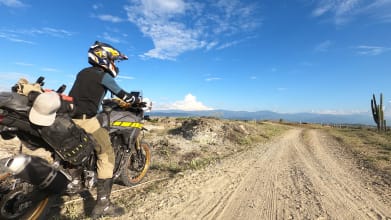

“I pulled into Nazareth, was feeling ‘bout half-past dead” is Robbie Robertson’s first line of a song about carrying the loads of others. Muzo was our Nazareth. A mining town full of depravity and exploitation. A hard landing, no refuge from the weight accumulating in our crew after only two days of riding together.
The whole song is about people doing their own thing and transferring “weights” to others in different ways. A kind of craziness that makes no sense, but we all do it.
“Hey mister, can you tell me where a man might find a bed? / He just grinned and shook my hand. ‘No’ was all he said.” No refuge from the burdens we were each beginning to carry:
Evan’s burden of not knowing where our bikes were and not trusting the people I had hired to get them there, and trying to transfer it to everyone.
Aaron’s burden of thinking he was the only one who could fix everything for everyone.
Tucker’s burden of not accepting that he’s on a trip with a group and can’t be completely independent, pick his own route, or go at his own leisurely pace.
My burden of assumed, not granted, group leadership — and holding myself accountable for everything that had gone wrong to this point.
“Well, Luke, my friend, what about young Anna Lee? / He said, do me a favor, son, won’t ya stay and keep Anna Lee company?” No bikes. My research, my work, my plan and booking had gone awry. Empty messages from Veronica. Everyone turning to look at me. I raised my hand to put this trip together. Now I carry everyone’s worry about when the bikes will show.
“Take a load off, Fanny / Take a load for free / Take a load off, Fanny / And you put the load right on me.” The chorus cuts both ways. Taking a load off someone is generosity. Putting your load on someone is theft. Same lyric, opposite acts. Aaron shaving down a helmet liner, checking everyone’s tire pressure — that’s the first kind. But it also robs the rest of us of a chance to carry something. I was doing the same thing, in almost the same way, with the route planning and mapping.
“When I saw Carmen and the devil walking side by side / I said, hey, Carmen, come on, let’s go downtown / She said, ‘I gotta go, but my friend can stick around.’” This stanza captures how I felt descending from the safety of a well-traveled public road to a river devoid of soul. Environmental degradation, razor wire, despair. Just to see if we could get a better deal on emeralds at the source. It didn’t feel right. A moral compromise, another accumulated burden.
We caught our “cannonball” out of Muzo the next morning, our bags sinkin’ low. We rode out carrying everything we rode in with, and then some. The weight doesn’t come off; it just redistributes.
In case you missed it, Chapter 7 of Honest Miles dropped last Sunday. Check it out here:
