

I sleep like crap on the worn bedspread and sheets. An overachieving rooster starts crowing at 3:00 A.M. outside my window. Tiny “no see ‘em” mosquitoes buzz my ears on and off all night. Morning comes fast. My neck aches from the flat, tired pillow that smells of sweat.
We meet downstairs at our agreed-upon 7:00, and head out to the restaurant around the corner, where we had eaten the night before. The sun has not yet peeked over the tall, forested mountains that surround the town. The air is heavy and still, and already feels suffocating. We order coffee, huevos fritos y jamón con arepas (fried eggs, ham, and arepas), a standard in Colombia. The too-weak coffee comes quickly. We sip it as we watch the street outside begin to wake up.
“I brought my helmet to see if we can tweak it to fit better,” Evan says. “The thing gave me a headache all day yesterday.”
“Where does it hurt?” Aaron asks as he reaches for the helmet.
“Right here,” Evan points to his forehead.
Aaron jumps in and takes over before discussing a solution with anyone. He borrows a knife from the kitchen, removes the liner from the worn black rental helmet, then starts shaving the protective foam from the front of the helmet, removing about a quarter inch of material. He reinstalls the liner and hands it back to Evan. “Try this.”
Evan pulls the helmet over his ears. “Better, could use a little more.” He hands the now-compromised helmet back to Aaron, and the process is repeated. This time the fix works. Less protective now, the helmet won’t be causing Evan more pain.
“I made a really cool off-road route for today,” Tucker says.
“Send it to me so that I can have a look, I just sent everyone the one I made last night,” I reply.
Tucker fiddles with his phone and isn’t able to get the route to export properly so it can’t be shared.
“Let’s stick with Shaun’s route since we all have it,” Evan says.
“I’m cool with that,” Aaron agrees.
Tucker ignores the exchange as he continues to struggle with the download on his device.
After breakfast, the hotel manager takes us to retrieve our bikes from their stable. He removes the padlock and opens the makeshift steel door. With some relief, we find everything the way we left it the night before. We ride our bikes back a block, up the hill to the hotel, and park in front. We agree to head out no later than 8:45. Thirty minutes. Plenty of time.
We return to our rooms to pack up. On the way out, I pay for my room — 150,000 pesos, about $37, cash-only here. I arrive at my bike around 8:30, and Aaron is already there working on his. Evan arrives. Sorts some gear and plops his duffel on the bike. Then tightens a strap. Loosens it. Retightens. All three of us are loaded with our duffels within a few minutes. We share Aaron’s tire gauge to check tire pressures while we wait for Tucker to arrive. Aaron checks Tucker’s.
8:45 rolls around, and Tucker is still not down. The sun peeks over the top of the west-facing, three-story hotel and immediately heats the morning air to a muggy heat. I begin to sweat. The three of us are looking for shade while we wait for Tucker.
He finally appears. “What’s up, guys?” he says enthusiastically. Aaron glances at me. I meet his eyes, which roll, then look away. No one says a thing.
“I checked your air pressure, the rear tire is at 26 psi and could use a top off,” Aaron says to Tucker.
“Thanks, man, you’re awesome,” Tucker replies with appreciation.
“Let’s take care of it when we fuel up,” I say.
While Tucker loads his belongings, I study the road ahead on the map. I think about distance. About heat. About daylight, already slipping. I suppress my urge to push things along. Our destination today is Muzo, a short 90 miles, but in unknown terrain.
Tucker’s gear is the most extensive of everyone’s. He brought everything he planned to ride with on the trip from home, since his bike was coming directly from Miami, where he bought it sight unseen. He piles his gear on the sidewalk next to the bikes and begins stuffing items into the bike’s side panniers.
“Can we help,” I ask with annoyance.
“Don’t hurry me, it will only take longer,” he retorts.
Panniers loaded, he grabs his giant yellow dry sack duffel and straps it to his tail rack, then takes the fishing pole he has hauled down here and slides it under the straps. The uneven load bulges.
Tucker finally mounts up, and we roll out at 9:15. No one comments on the time.
Before heading southwest to Muzo, we head a couple miles north to check out a waterfall that supposedly flows through a hole in the side of a cliff — the reason we stayed in Florián. A Tucker find. At the waterfall, the tension loosens. We park on the side of the narrow road and dismount. A small, faded sign marks the trailhead.
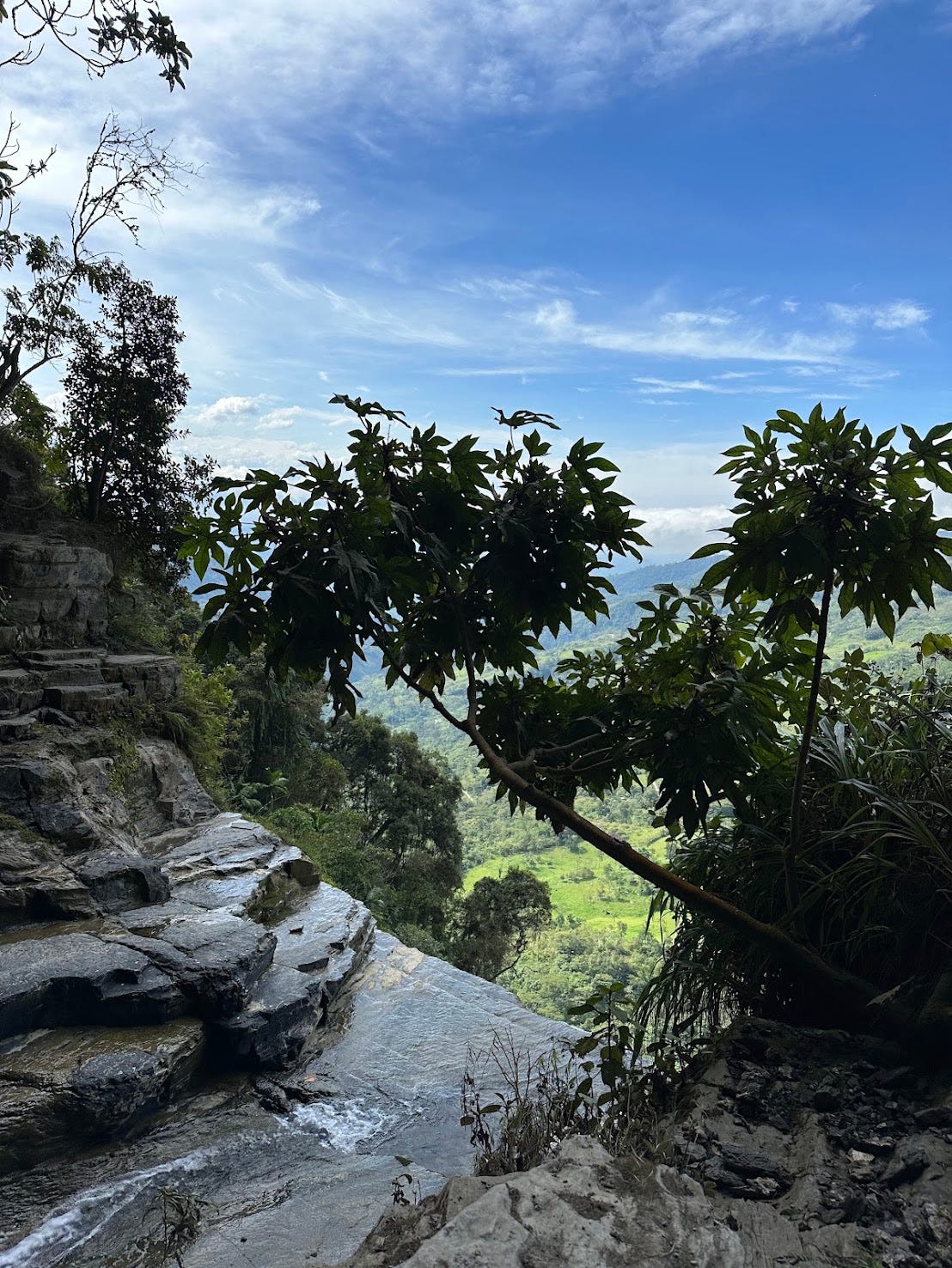
We hike a couple of hundred feet down a steep, slick trail to a rickety suspended footbridge that crosses a stream bed flowing into a cave — really a grotto with a 50-foot ceiling. We scramble down the damp, mossy rock footing and around automobile-sized boulders to a slow-moving stream, a trickle this time of year. We then follow it to where it exits the cave, here it drops 1,400 feet straight down. I can see Florian tucked in the rainforest on the side of the mountain, a few hundred feet lower and a mile or so to the west. I’m noticing the lack of graffiti, trash, or broken bottles that usually accompany sites like this in most parts of the world.
A weak mist rises. Hummingbirds buzz around, nectaring on the jungle flowers that surround the mouth of the cave. It feels mystical. We speculate about what this place might have meant to indigenous people. Did they perform rituals here? Sacrifices? Burials?
We linger, trying to capture some photos of the birds. Eventually, I start back up the trail, hoping that my exit will suggest it’s time to move on. Evan and Aaron follow.
Back at the bikes, Aaron, Evan, and I are ready in five minutes. Helmet on. Gloves on.
Tucker is still coming up the trail. Many great photos to be had. We wait another five minutes. It’s now 11:15, time to roll.
We ride the two miles back into Florián and fuel up at its only gas station. Aaron helps Tucker top off his rear tire while Evan and I take turns topping off our bikes. I pay for both to save time, and Evan agrees to get the next tank. After Tucker and Aaron are ready, we head out of town the way we had come in.
* * *
We leave Florián behind as we ride past the same small rows of shacks from the night before, all feeling less substantial and quieter in the glare of the sun now directly overhead.
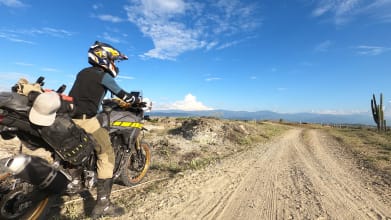
We decide to distance ourselves to let the dust settle between bikes, agreeing to stop at every intersection so we can stay together. We all have the day’s route up on our screens. Aaron leads, me next, Tucker, then Evan. The road is more traveled during the day, with a steady flow of farmers on small motorbikes, occasional tractors, and overloaded agricultural trucks carrying varying loads of harvested crops. The road is not wide enough in most places for two vehicles to pass, and it’s tight even for our motorcycles when oncoming trucks approach. The going is slow and dusty.
About 10 miles out from Florián, we come to a small village where our route splits from the route we took from Bogota the night before and turns west toward Muzo. By the time I arrive on the edge of town, Aaron is pulled over and waiting. I pull alongside him and shut the bike down. We both remove our helmets for a drink of water and a snack. After a short wait, Evan arrives before Tucker.
“Evan, did you pass Tucker?” I ask.
“No, I never saw him,” he replies. “I thought he was in front of me.”
“He was,” I reply.
“I wonder if he took a wrong turn,” Aaron says.
I pull my sweaty helmet back on so that I can use the intercom to try to reach him. “Tucker, come in. Do you hear me?” No response.
A couple of minutes later, I try again, but nothing.
“Let’s have a snack and wait a few more minutes,” Evan suggests. We do.
“I’ll try him on my phone,” Aaron says. “I’ve got two bars here.” No response.
I finish my energy bar and have some water. “I’ll ride back to see if he’s OK,” I say, hoping that he hasn’t crashed or flatted.
“We’ll wait here,” Aaron replies.
I head back the way we came in and ride about three miles to the point where I last saw Tucker in my rearview. He’s nowhere to be found; I’m now worried. I turn around to ride back to Aaron and Evan so we can formulate a plan to find Tucker. As I pull up to where I had left them twenty minutes prior, I see three bikes parked. I pull up and remove my helmet.
“What the hell, where were you Tucker?” I exclaim.
“I decided to explore the route I made last night to see if it connected to where we are going,” he replies. “It dead-ended into a single-track goat path.”
I feel my blood pressure rise now that I know his detour was intentional. “Dude, we were worried about you. We’ve been waiting 45 minutes. We have to stay together out here.”
I’m pissed.
“I agree,” Aaron says calmly, but with annoyance. “Let’s stay together.”
“And on our agreed-upon route,” I add.
“Yeah, probably a good idea,” Tucker says.
Evan, who is still getting a feel for the group, sits quietly on his bike and looks away from the conversation.
“We should hit the road, it’s almost 12:30, and we’ve only made it 15 miles,” I say.
* * *
We settle in on the ride for the day, a mix of dirt and poorly maintained paved two-lane mountain roads. We arrive in Muzo around 4:00.
“I guess I was wrong about how long it would take to get here,” I say over the intercom as we roll in.
“It was a fun ride, glad we’re here before dark,” Aaron says.
Muzo is the emerald-mining capital of Colombia, and like most mining towns, it feels raw and uneasy. Gaunt men, young and old, walk the sidewalks in the dead, humid heat, their ragged clothes and hands stained black from the shale that hides the tiny emeralds. I see very few women or children. Aside from its emeralds, the town was the site of the Guerras Verdes (green war) between El Chapo’s drug-cartel-funded Marxists and the government, which ended in 1991 after claiming nearly 10,000 lives. The pall left by the conflict 30 years prior lingers.
Tucker locates a hotel on a booking app at the edge of town, more of a walled motor lodge. The heavy-wheeled gates are locked shut when we pull up. He buzzes reception on the scratchy intercom. A teenage boy shows up in a few minutes, unlocks the gate, and rolls it open. We ride through and park in a covered area near the front office. It feels more secure than the night before.
While Tucker talks with the receptionist, I spot beers in a small refrigerator in the corner. I grab four Aguilas and pass three to my friends as we go through the slow registration process. The cold beer goes down quickly. I grab four more before paying the receptionist for all eight.
My ground-level room is air-conditioned. I unpack my gear and take a cool shower. I head to the small courtyard and try to call Betty. Voicemail. I text instead — “We are in Muzo at our hotel, fun ride, call when you can” — and add a red heart emoji. Aaron and Evan join me at the small round metal table where I sit.
After a few minutes, Tucker rolls in carrying a six-pack of beer. “I talked to the hotel manager. He hooked us up with a tour guide who will take us to an emerald dealer who will open his shop for us tonight. 20,000 pesos for all four of us, about $60.”
“That sounds great,” I say with hesitation, reluctant to commit to a guide who doesn’t speak English. But the others are up for it, so I go along.
The tour guide arrives on a small dirt bike. He walks us toward the center of town past a small arena where kids and families are beginning to gather for a soccer match, halogen lights already blazing. The emerald dealer is there when we arrive at the storefront, inside with a younger version of himself, presumably his son. They unlock the door and show us around.
The store shelves are sparsely stocked with necklace pendants, small gold rings, and earrings, none of high quality. I start examining the raw stones and think of Betty. There is no way I would buy her a piece of jewelry; she is far too particular about what she wears. I decide to find three stones of similar shape and quality for her to have set in something she would value. A gift with real meaning, and something she would wear with her designer brands. The thought process makes me miss her more.
He explains in Spanish how emeralds are graded for darkness, clarity, and occlusions. Tucker translates. Aaron and Evan look around but aren’t buying. I feel rushed. The owner brings out several small white envelopes and empties them onto a tray under a bright light with a magnifying lens, pointing out the specific traits of each stone. It takes me about 15 minutes to find two that are close in color and size. I can’t find a matching third.
The merchant breaks out his calculator and scratches a number on a small pad: 1,500,000 COP (about $450). I respond with 1,000,000. We settle on 1,250,000. I instantly feel I’ve been swindled — I hadn’t considered the cut for the tour guide, and possibly the hotel manager who recommended him. I watch as he carefully folds the emeralds in white paper, then inserts them into a white envelope. I dole out fresh bills. He hands me the envelope across the counter.
Tucker completes his own purchase.
The merchant closes and locks the door as we exit the store. It’s almost dark outside. The guide takes us across the plaza to the Emerald Museum, which is officially closed but open for us by arrangement. Like the town, the museum is tired — poorly lit exhibits of miners’ tools, ore reproductions, and photos of revolutionaries. Fifteen minutes to see the whole thing.
Exiting the museum on the plaza, I notice the ragged population again. I can’t stop thinking about whoever controls this trade — the men who never get their hands dirty. The buyers, sellers, traders, and exchanges. The disparity scares me deep down and makes me want to keep moving.
We eat dinner at a small restaurant, then head back to the hotel.
“The guide will take all four of us to see a mine in the morning, $20,000 pesos each,” Tucker announces. “He’ll meet us here at 6:30, breakfast at his place first, should be done by 10:00. Should we do it?”
“Sounds good to me,” I vote. The others agree.
“Let’s sort out tomorrow’s route before committing,” I suggest. “I plotted one that looks interesting.”
“Yeah, I did too,” Aaron says. We compare them. His is slightly longer, about 80 miles, but it’s impossible to tell which will be more interesting.
“I vote we take Aaron’s route,” Tucker proclaims without having looked at either.
“How can you pick a route without looking at the options?” I ask.
“Let’s take Aaron’s route,” he replies. “It will be more fun.”
My temples pulse with the dismissal. I suppress the feeling. “All right then, shoot us the track on WhatsApp, Aaron.”
* * *
It’s light out, but the sun isn’t up yet, and it’s relatively cool. We are all ready to depart the motel at our agreed-upon 6:30 AM. The tour guide arrives on his dirt bike. We follow him past the edge of town, a few miles down a wooded dirt road, before turning sharply up a narrower steep road. We ascend a series of switchbacks through the rainforest. Partway up the mountain, we pull into a crudely developed parking area that overlooks the town a thousand feet below. There we are led up a path to a couple of outdoor picnic tables. Pigs and chickens roam the yard.
We are seated at the tables, and a woman comes out of the house almost immediately with a tray of small coffee cups and a small milk pitcher. We sit sipping the weak coffee and quietly talk about what might be next. Then the guide and the woman return from the house with four plates of fried eggs, ham, and arepas, along with fresh guava juice.
After we eat, the guide explains to Tucker, who translates, that we will be hiking up a steep path to an abandoned emerald mine for a tour. He brings us rubber boots and hard hats with lights on them. We swap among ourselves, trying to find the best imperfect match.
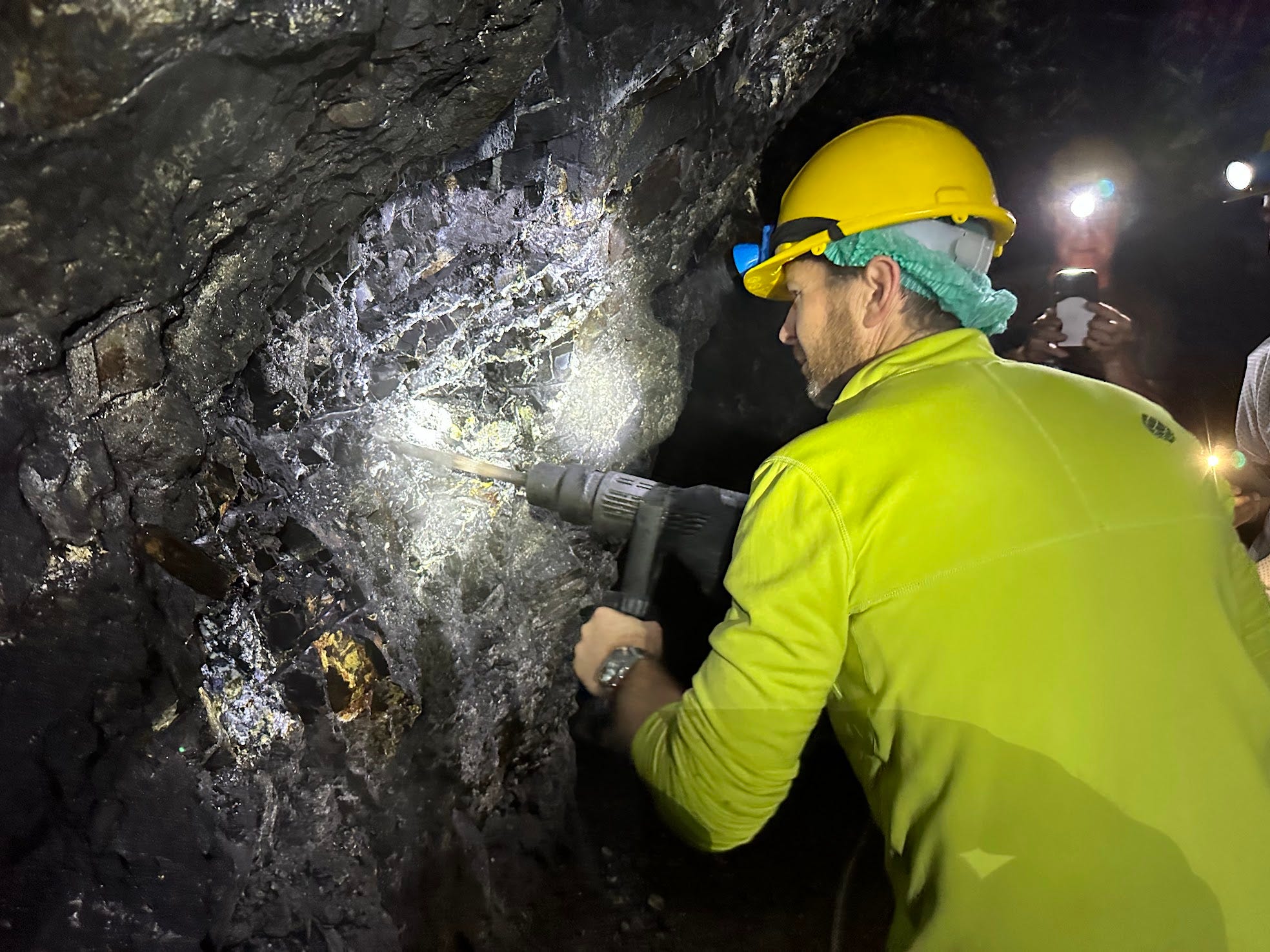
The guide leads us out of the yard with an electric jackhammer slung over his shoulder. He hands Aaron a five-gallon plastic bucket to carry and hands Evan a rolled-up screen. We hike about 15 minutes to a small, crooked mine shaft entrance nestled on the steep wooded slope. The old timbers supporting the shaft entrance are tired. The inside of the mine appears completely black, like coal. We crowd around the door, perched on the small flat area in front of the opening, while the guide connects the jackhammer’s power cord to a generator. He fires it up before handing each of us a pair of foam earplugs. Then he leads us in.
We crouch as we walk about 100 feet down the shaft; it’s completely dark except for the beams from the cap lamps on our hard hats. Water drips. The guide stops and signals us to stand back. Then he begins hammering aggressively into the black walls with the jackhammer. Shale crumbs and chunks the size of walnuts accumulate at our feet.
Then he hands the jackhammer to Tucker, who repeats the process for a few minutes. We each take a turn. It feels like a hundred degrees in the cramped tunnel, and I’m beginning to feel claustrophobic. After we each have a turn with the jackhammer, the guide shovels the shale ore into the plastic. We turn and begin exiting the shaft, our pace faster than when we came in.
It takes my eyes a minute to adjust when I exit the pitch black of the mine, the day’s sun now fully up. I feel like I can breathe again.
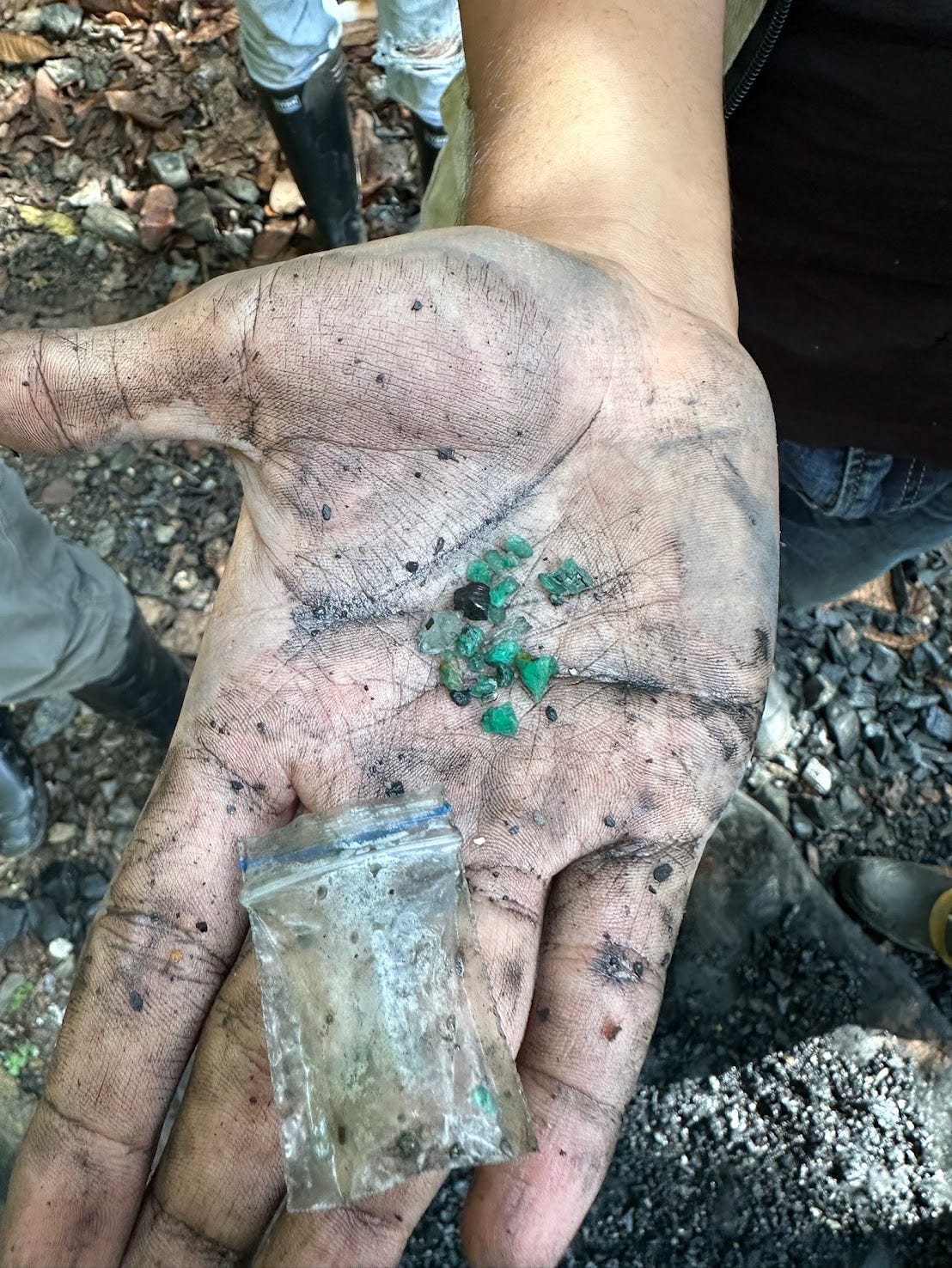
The guide grabs the screen he had stashed beneath a bush and turns on a water hose. He dumps some shale onto the screen and positions Aaron and Evan opposite each other, each holding two corners of the screen. He begins running water over the screen and motions for them to start shaking it back and forth. The shale crumbles and washes off the screen. After about five minutes of shaking, we find our first emerald. A green, cloudy, cracked breadcrumb of a gem. Then another, and another. We are all now focused on the screen and on what riches we might find.
After about five minutes of shaking, the guide dumps a fresh batch of shale on the screen. Now Tucker and I give it a try. We find a few more of the same cloudy gems. The guide lets us keep our loot and gives us a small ziplock for safekeeping. I notice that my hands are now black.
Before we leave, Tucker asks the guide about a place he had read about, where active mining still happens, the Rio Minero. The guide says we can check it out, but warns us that it is still a commercial operation. He offers to take us there for another 20,000 COP each. We decline, opting to explore it ourselves.
* * *
On our way back through Muzo, we fuel up and top off our tire pressure for our 110-mile ride. Tucker’s tire is low again, not his fault, just a slow leak. While he tops it off, I check my messages for an update from Veronica.
“Motos are still in Miami customs, will update when I learn more,” is what I read. I read it aloud to the others.
“I think we are being scammed,” Evan replies.
The rest of us dismiss the accusation.
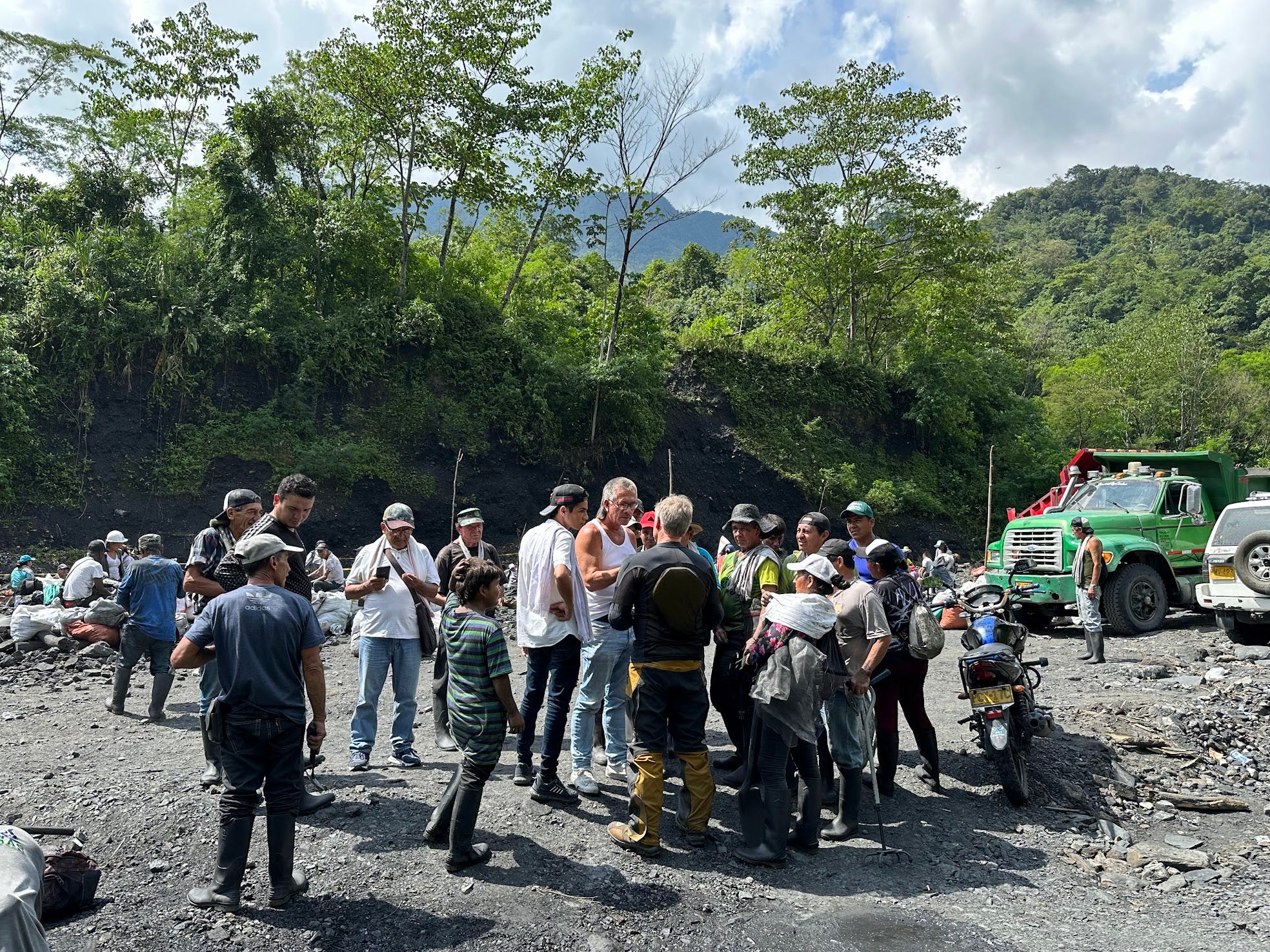
We head out of town on a well-traveled, wide dirt road that leads us through a small gorge. We can see the river a few hundred meters below us. Just past the gorge, we turn off the main road to another well-developed dirt road that descends to the river bottom. The road is lined with chain link fences topped with razor wire. There are buildings perched on the steep hillside that suggest commercial operations, and the military presence here is felt. We don’t see anyone on the road or behind the fences. I still feel we could be stopped and turned back any minute by an armed patrol.
We continue to the bottom, where we encounter a river about 50 yards wide.
The plain is devoid of flora. Piles of black tailings the size of small huts litter the drainage as far as we can see upstream or down. We stop to check it out, then decide to cross. I go first. It’s not deep or slippery, and the KTM crosses without incident. The rest follow.
Once across the river, we spot about 50 scattered miners, each sluicing for emeralds. They begin to notice us and our four orange KTMs on the shore and start setting down their tools. I immediately think about how each of our bikes is probably worth more than these miners earn in a year or two of hard labor. We dismount the bikes and remove our helmets.
“Let’s go see if we can buy some emeralds from them,” Tucker says.
“I bet we can,” Aaron replies.
I’d already blown my emerald budget the night before and wasn’t interested in buying more. I was still curious about the miners and what they had to offer. Something tells me this place is not safe. Not just a place to get ripped off, but possibly robbed. I get the sense that very few outside visitors who are not in the emerald trade venture here.
“I’ll stay behind to watch the bikes,” Evan offers.
“Thanks,” I say, “good idea.”
Tucker, Aaron, and I walk toward the miners, who have now gathered in a group of about 15 or 20. A particularly muscular, tattooed, and assertive leader, less dirty than the others, approaches us and does the talking. He controls the conversations with each miner as we inspect their gems one by one. A couple of miners try to bypass the leader and are quickly put back in line.
Each miner reaches into their trousers and shirt pockets, retrieving small, dirty, folded envelopes containing their daily finds. The circle now closes around us, tightening with the excitement of making a deal. The miners empty their emeralds into their dirty palms to inspect. Two, three, five stones at a time. Most are larger and darker than the ones we had mined ourselves earlier in the day.
We find the prices lower than at the Muzo store, but the stones are not curated. Tucker and Aaron each find a couple they want to buy. We are short on cash, so we pool our pesos to finalize the transaction and pay the leader directly.
When we start walking the 50 yards back to Evan, I notice that a few straggling miners have approached him directly from upstream with their wares. He does his best to ignore them, but I can tell he is uncomfortable with their approach.
Back at the bikes, we quickly put our helmets back on, trying to ignore the onslaught of approaching miners the way one does when closing the windows on a car to keep the mosquitoes out.
“No estamos interesados en comprar más esmeraldas,” Tucker repeats more than once, clearly communicating our disinterest. They don’t leave us alone until we fire up the bikes and begin to ride away. I’m thankful for his language skills.
As we ride along the riverbank and back across, I feel like I’m being watched all the way to the main road.
Thanks Todd... It's comments like yours that keep me going down this path!
Any definite plans for the next installment? Great stuff; hope you continue down this path