

Thank you, my loyal subscribers, for checking in on Honest Miles and me while I took a few weeks off from releasing chapters. I needed a summer break from drafting, editing, and editing. It meant a lot to me that so many of you reached out asking for the next installment. Here it is! Enjoy.
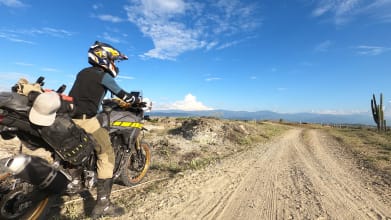
We immediately ascend 3,000 feet from the mine to a ridgeline that more resembles a knife edge extending for miles to the west. The rutted, red dirt road etched into this edge divides the 40-degree slopes on either side. It’s plenty wide for most four-wheeled vehicles, but I feel like I could go flying off into the abyss with the slightest hit from a rock. Ridges like this can be seen for miles in the distance, spidering off the Cordillera Central.
Aaron and Evan are riding fast out front. Tucker and I are riding slower, trying to take in the amazing terrain without crashing. I decide to stop on the edge of a switchback so I can snap photos of Tucker as he rides toward me. He pulls alongside me and stops.
“Incredible road, I’m really glad we came this way,” I say.
“Unreal! I’ll ride down to the bottom of that ridge and catch a video of you riding down,” Tucker says.
“Cool, thanks, man,” I say. I take a video of him as he descends to the saddle below.
I give him a minute to set up. I see him wave and give me a thumbs up. I start my bike, stand up, and head his way. I ride past him and keep going slowly to let him gather his things and catch back up.
Eventually we hit a recently paved two-lane highway. The day’s feel changes immediately from wide-open countryside to the hustle of a busy, winding two-lane. Green box trucks dominate the road in both directions, tilting over the center line, almost on two wheels as they round each curve. Motorcycles and scooters try to pass between the hairpin turns. I’m immediately thrust out of my element and feel my forearms tighten as I grip too hard. I keep thinking, “This cannot be safe.”
Something doesn’t feel right on my bike. Each time I lean into a turn, the rear end rolls, then drifts. It feels impossible to hold a steady line in each curve. I go through a checklist in my mind. Loose rear axle? Low tire? Issue with the suspension?
“I’m pulling over, want to check something on my bike,” I announce on the intercom less than ten minutes after turning onto the highway.
Aaron, in the lead, responds, “I’ll pull over at the next turnout.”
He finds a sliver of a turnout on a left-hand curve. Tucker and Evan pull in behind us. I dismount, aware that there are only a couple of feet between me and the trucks flying by on the highway. Aaron dismounts and heads over to examine the bike with me.
“It wants to tip then drift on the hairpins; it won’t hold a line,” I say.
“That’s unusual,” Aaron replies.
“Probably my inability to ride pavement,” I joke, half meaning it.
I give the rear tire a couple of hard kicks to see if anything moves. Nothing. I borrow Aaron’s tire gauge and check the tire pressure; it’s 32 PSI, just fine. After examining the rear tire, I notice that the middle treads have been worn flat, probably from the thousands of miles the bike has done on pavement with Jorge’s tours up and down the Pan American highway.
“Take a look at the profile of the tire,” I say.
“That’s probably it,” Aaron replies. “It’s squared off.”
“I’ll live with it. Let’s go,” I say. “You guys go in front; I’m going to take my time.”
I let Evan and Tucker pull in front of me in case they want to ride fast out front with Aaron. We wait for an opening in the truck traffic; the four of us pull out, drag racing quickly to gain speed before the next truck comes bearing down on us.
Now knowing that I’m riding on tires with compromised tread, I’m even more tense on the winding tarmac. I see every hairpin as a threat that will drift me off the road to the right, or directly into oncoming traffic to the left. I feel unsteady and ride without aggression or confidence.
Aaron pulls out to pass a truck on a short straightaway. Tucker follows, barely missing an oncoming motorcycle in the opposite lane. “Jesus, that was close,” I hear him say on the intercom. Evan passes on the next straightaway.
“I’ll catch you guys at the next intersection,” I say over the intercom.
They all disappear from sight and range of the intercoms.
At the bottom of the pass, I find my three friends waiting for me. I stop, turn off my motorcycle, and remove my helmet. The heat and humidity are more intense here than they were at the top of the pass, 4,500 feet above us. I can hear the whine of truck tires on a highway in the distance.
“Aaron and I rocked that two-lane down the mountain,” Tucker announces. “We must have passed 10 trucks! What a blast!”
“It was fun,” Aaron says.
“I want more of that,” Tucker exclaims.
“Really fun, but the trucks are insane,” Evan says.
I feel excluded from the experience, knowing I had ridden the road not for fun, but for survival. The thought crosses my mind that I am now the one holding the crew back. I choose not to respond, knowing that the only thing I could say would place the blame on my machine.
“I’m going to grab a drink of water and a snack,” I say.
“I just had one,” Tucker says.
“Hear the trucks? We must be close to a four-lane,” I say.
“Yeah, this is where we get on the Pan-Am for 20 miles to get us to Honda,” Aaron says. He’s been here for a few minutes and has studied the route on his phone.
I finish my energy bar and stow my water. “Let’s roll.”
We enter the Pan-Am and accelerate to 70 miles per hour; I pass the others without thinking and am now in front. The road reminds me of Highway 280 in the Bay Area, where it winds its way with high-speed, banked curves through the foothills, except here there are fewer cars and more trucks. I am not surprised the bike drifts more on the curves at these speeds. There are no straightaways, so passing the trucks only happens on the high-speed curves; the buffeting from the turbulent air they create throws the bike side-to-side, adding to the instability already created by the tires.
We ride the Pan-Am about 20 miles before exiting onto a busy two-lane into Honda, our destination for the night. We cross the Rio Magdalena into town. The Magdalena is the main river flowing through central Colombia, running 1,500 miles from the Andes to the Caribbean, where it flows into the sea at Barranquilla. Founded in 1539 by the Spanish, Honda was the main port city on the Magdalena where goods were transported to and from the inland city of Bogotá. It is also known as the “city of bridges” because of its 40 bridges that cross the four rivers that converge there.
We ride past tractor dealerships and supermarkets as we enter the town of 24,000. It feels clean here, almost cosmopolitan compared to the villages and towns we have passed through since leaving Bogotá. The one-way cobblestone streets are narrow and lined with two-story whitewashed walls. The storefronts and dwellings are marked by few windows, just small signs and large wooden doors that open into courtyards. It feels like riding through a white maze.
I lead the group into town and navigate to the hotel. We arrive around 5:00. The hotel’s arched entrance has 15-foot-high solid wood doors set into tall whitewashed stone walls. No windows onto the street, just a small sign announcing the “Posada las Trampas.” Tucker hops off his bike and buzzes the intercom. Within thirty seconds, the huge wooden doors swing open, and a man and a woman greet us, each wearing the hotel’s uniform: black slacks and white pressed shirts.
* * *
I found Las Trampas advertised on a booking site when we stopped for lunch earlier that day, marketing itself as a “Luxury Historic Villa.” We were only four nights into the adventure and were relieved to find this gem of a hotel. Well worth the $150 rate, which was 4-5x the cost of the places we had stayed the prior two nights.
The receptionist points us to an area near the entrance to the sloped courtyard, where we line up our bikes and dismount. I put my kickstand down and lean my bike over, not noticing that it has slid between two slick cobblestones. The bike tips further, then falls over, heavy side down.
Aaron and Evan rush over to help me lift the bike back to its wheels. “Thanks, guys,” I say with embarrassment.
“The hotel looks nice,” Aaron says.
“Excellent choice,” Evan agrees.
While we check in, a server dressed in all white brings us glasses of cold maracuyá (passion fruit juice). A porter, also in white, grabs our things and starts carrying them to our rooms.
The eighteenth-century mansion has ten rooms, each with air conditioning and 14-foot ceilings, all meticulously decorated with a combination of native and colonial artifacts. It’s a designated heritage site in Colombia.
After checking in, I head to my room and call Betty.
“Hey hun,” she answers.
“Hey babe, how are you?” I ask.
“Tough day at work; I’ll fill you in later,” she says.
“What’s going on?”
“I don’t want to talk about it right now,” she says with an edge. I let it go. “How was your day?” she asks.
“It was great.” I keep it simple, sensing she would probably resent hearing about the ride and the place we are staying. “We’re staying in a boutique hotel, a colonial villa that’s pretty cool.”
“Oh yeah, what’s it like?” she asks.
“Very clean, authentic, 14-foot ceilings. It’s built around a beautiful courtyard and has a pool in a second courtyard, tons of flowers,” I explain. “You would probably really like it.”
“That’s nice,” she says. “It’s snowing back here, and the dog has diarrhea.”
I choose to keep my enthusiasm to a minimum. “Sorry to hear that,” I say with strained empathy.
“I’m headed to work out before meeting a client for dinner,” she changes the topic. “What are your plans for tomorrow?”
“We have a shorter day; we plan to start a little later,” I explain. “Give me a call when you wake up.”
“Love you, be safe!” she says.
“I love you too.”
I lie back on the bed for a few minutes to absorb the conversation. I feel alone and distant from her. I don’t wish I were there.
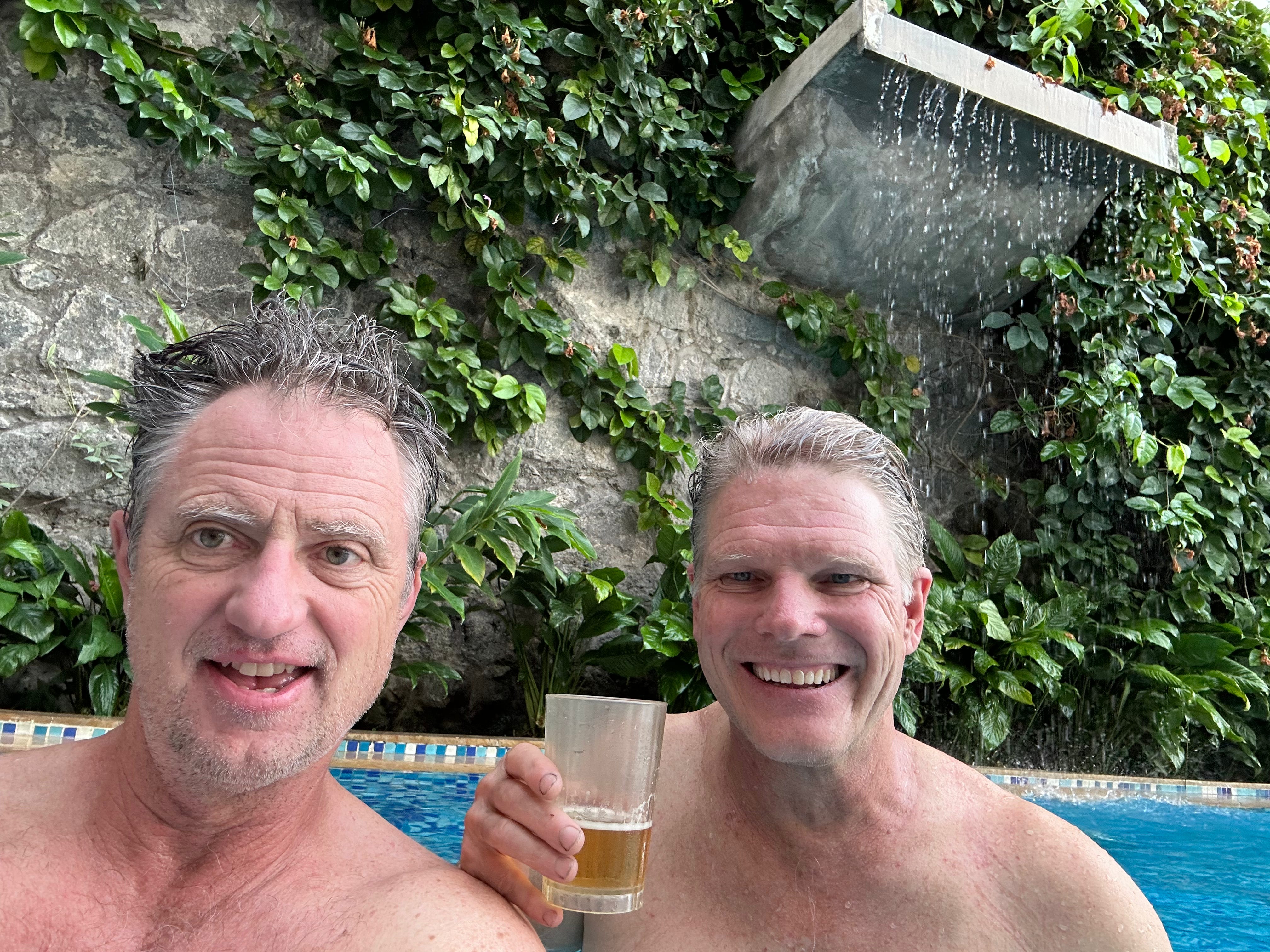
I change into my board shorts and head to the pool where I find Tucker. He has already ordered a round of margaritas and beers to get things started. The cool water feels incredible. We recount the day, the characters we met in Muzo. We laugh. We agree to meet at 8:00 in the on-site bar before heading out to dinner.
Back in my room, I gather my riding shirt and jeans, both filthy after two days of dirt roads, and put them in a cotton laundry bag for housekeeping. Aaron and Evan do the same. Before turning it in, I confirm that they will be returned before our 9:00 AM departure.
I decide to check my email, which I have neglected for two days. I open my tablet and see a string of messages labeled “URGENT” from the CEO of Torrent, a software company I co-founded and currently chair the board of. I open the first message in the chain, sent early yesterday.
“Shaun, it looks like we are going to miss our 4Q revenue numbers again. Cash is low; we need to talk. Let me know when you’re available.”
I reply via text from my phone, more immediate than email: “I saw your email. I can talk anytime for the rest of the evening. Please call me.”
We head out for dinner at a nearby restaurant with contemporary Colombian food. Aaron and I order a bottle of Chilean wine and finish it before dinner is over. We recount the day — the mine, the ride, ripping down the knife-edge ridge — and the mood is light. I find it difficult to engage, now preoccupied by my conversation with Betty and the troubles with Blaine.
Back at the hotel, we take over the small bar lounge and order more cocktails. Tucker finds the tiny ziplock with the emeralds we had mined earlier in the day and dumps them on the small coffee table for us all to examine.
“Pretty sweet,” Evan says. “Wonder if they’re worth anything.”
“I don’t know,” I say.
“I bet you could make a cool bracelet or something like that,” Aaron suggests.
“How should we split them up?” Tucker asks.
“What if we played cards to see who gets them? Winner takes all,” I suggest.
“Great idea. Let’s keep track of our scores each time we play. Whoever has the most points at the end of the trip wins,” Tucker suggests.
Tucker has already anticipated a card game and breaks the cards out from his jacket pocket. “Let’s play!”
We order another round of drinks and play two rounds of Screw Your Neighbor. Tucker wins again. At 10:30 the server tells us it’s time to close the lounge. When I get back to my room, I find my washed and pressed clothes waiting for me on the dresser.
I check my messages and email again for a reply from Blaine. Nothing. I shoot him a text: “I’m headed to bed, but would like to catch up. Please call me if you’re available. I’ll leave my phone on.”