
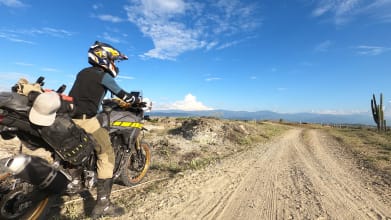

We exit the rainforest after about 20 miles of riding on slick, wet pavement and begin our ascent to Pensilvania. The steep, single-lane dirt road ascends through farms and small residential areas. Some especially steep sections are paved with concrete in short sections, but the practice seems random rather than planned.
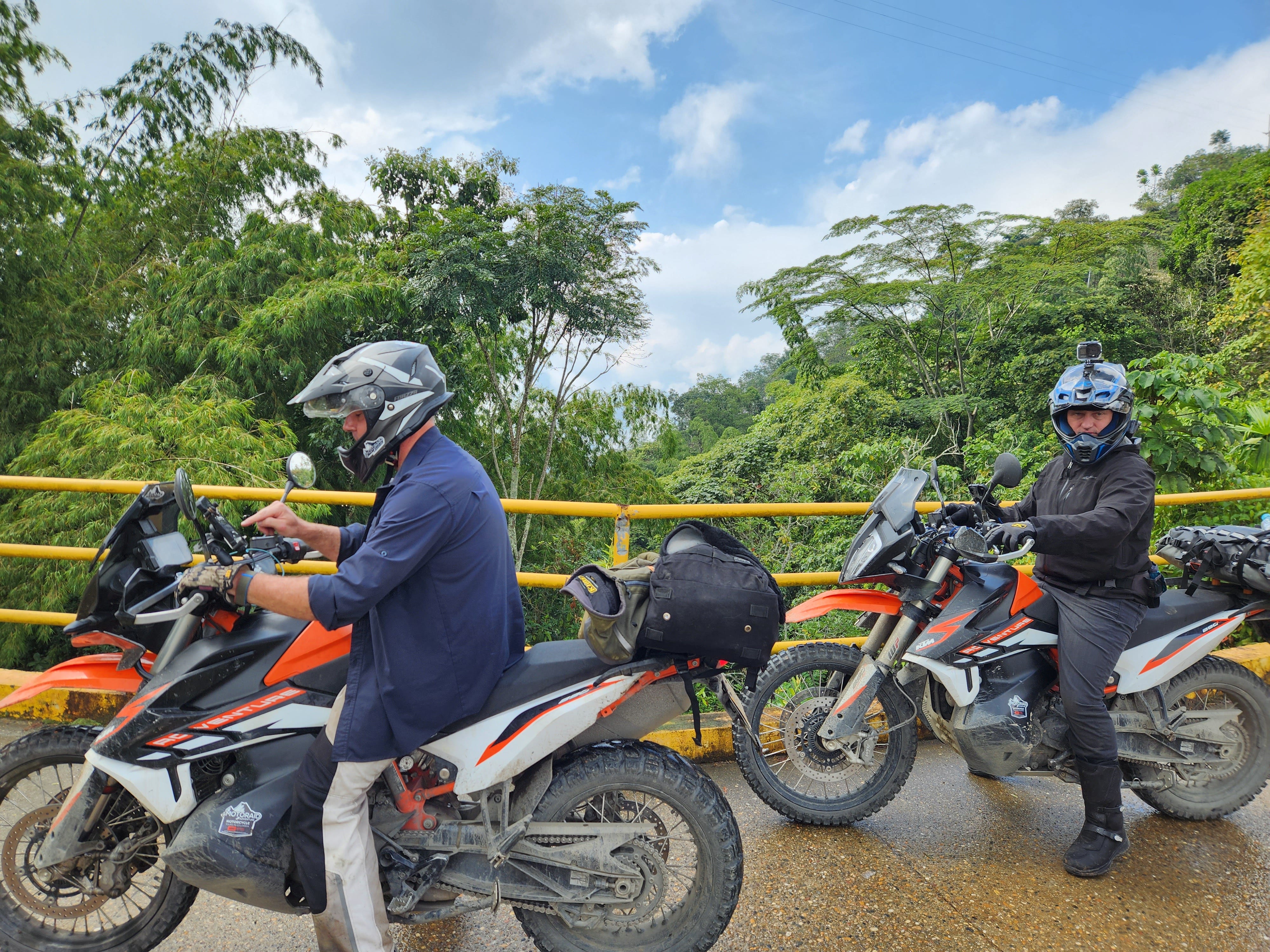
Rounding a steep switchback while staying on the throttle to avoid losing upward momentum, we encounter a road crew that has completely closed off the one-lane road for paving. I’m in front, have stopped, and rolled backward at an angle to prevent my bike from falling over on the incline. Aaron sees and stops far enough back to give himself room to do the same.
The workers stop when they see us approach, looking happy to have a diversion from their labor. Five of them with hand tools and a gas-powered Portland cement mixer. The forms they are setting are made from a hodgepodge of scrap wood. The wet concrete they have poured today spans about two meters of the twenty or so they have prepped for paving. There is no detour around the construction and the road is blocked in both directions. To turn around would detour us at least 50-60 miles.
Tucker and Evan pull in behind us and park their bikes parallel to ours on the steep hill.
“Are we going to be able to make it around these guys?” Aaron asks.
“I’m not sure,” I respond. “It looks like we might be able to edge around their forms on the side of the road.”
Meanwhile, the workers have moved the wheelbarrow blocking the path around the concrete forms. One begins smoothing a narrow path in the sand on the side of the road. Another approaches and speaks to us in Spanish, too fast for anyone other than Tucker to understand.
“They want to help us get around,” Tucker explains.
They wave me through first. I fire up the KTM and attempt to ride in the loose sand on the path but find no traction. I lose my balance, extend my foot to gain purchase, but find nothing but air, then dump the bike onto its side. Two workers immediately jump in to help me right the bike without hesitation. I start it up again and ease on the clutch while the two workers push from behind and I push from the bars. It takes a couple of minutes to make it over the two-meter section to the dirt road on the other side.
I carefully park the bike on the steep dirt road so it won’t tip over and head back down to help push the others’ KTMs around the job site. Meanwhile, two of the workers widen the path and knock down a couple of humps in the sand to make it easier. My riding partners make easy work of the section I struggled on.
“Seems amazing they would close the whole road,” Evan observes.
“I know. I wonder what happens when a truck or car comes along — no signs here,” I say.
“Hilarious, I guess they’re backing up this mountain or waiting a long time,” Tucker weighs in.
Three or four miles down the road, we pass a truck heading in the direction of the worksite.
Now we are about 60 miles southwest of where Pablo Escobar was headquartered when he dominated the world cocaine trade in the 1980s. At that time, approximately 13,000 hectares (32,000 acres) were under coca production in Colombia. Then, most of the coca production was in Peru and Bolivia. Colombia was simply the most geographically advantaged transit port for controlling the trade between South America, North America, and Europe. Today the number of acres of coca tillage in Colombia is estimated to be 18 to 20 times what it was in the 1980s — an area roughly 40% the size of Delaware. Economists estimate that the export value of Colombia’s cocaine crop is now about 3-4% of its GDP ($16-$18 billion) — larger than its oil and gas industry.
* * *
Knowing we are getting close to our evening destination, I restart my phone navigation and see we are about 20 miles out of Pensilvania. Saturday is when Colombians go to the “city” to socialize and shop. The road is busy with motorcycles carrying couples, dogs, and whole families. The 11 million registered motorcycles in Colombia outnumber autos by 50%; in the U.S., autos outnumber motorcycles by a ratio of 30 to 1. In contrast to Bogotá, where helmets are a requirement, nobody in rural areas seems to bother with the protection.
The roadside population is becoming denser, with small settlements every three or four miles instead of the 10-20 mile intervals behind us.
Several miles before the town, I pass a small motorcycle ridden by a man and a woman up a steep, rocky section of road — their riding is slow but smooth. The woman riding on the back wears flip-flops and holds a two-by-six-foot glass mirror with both hands while she balances on the bike behind her partner. I can see them conversing; the woman laughs.
We ride past a couple of small motorcycles headed in the opposite direction, dragging small 20-foot bundles of rebar. Everywhere we go, motorcycles do the work pickup trucks, delivery vans, and minivans would do in the U.S.
I’m leading on the road when we approach Pensilvania.
“Aaron, can you hear me?” I check the intercom to see how far behind he is.
No reply. Out of range, or a dead intercom battery.
I stop at an intersection before crossing a small bridge into town to avoid being separated from the others. After a few minutes, Aaron rides up alongside me.
I check the intercom. “Tucker, do you copy?” No reply. “Let’s wait here for a few minutes before riding into town; I don’t want to lose them,” I suggest.
“I think my rear tire is low; the bike wants to wallow,” I say as I jump off to investigate. “Yep, I’ve got a puncture. Wish I had my tire kit. Do you have any plugs with you?” I ask.
“Nope, my kit is on my Ténéré,” he replies.
“Mine’s on my Tiger,” I say, feeling the frustration of not having my gear.
“I’ll wait here for the others. Why don’t you ride into town and see if you can find a llantera? Stay on the main street; we will find you,” Aaron suggests.
I ride into the busy town on the main street. The sidewalks are crowded with locals enjoying their day off. The smell of empanadas, frying garlic, and spit-roasted whole hogs permeates the thoroughfare. Small motorcycles line the curbs, parked diagonally for blocks. I notice whole families dining at the many restaurants on the street even though it’s already 3:00 in the afternoon.
I’m hungry.
“I haven’t heard from the others,” I say over the intercom to Aaron, who is still a few blocks back. “I’m worried they may have flatted or crashed. Let’s get this tire inflated and ride back to find them.”
Meanwhile, an old man with the usual dark, leathery skin and a cooked limp of men his age here says something to me; I don’t understand him. He repeats himself and points to my front tire. “Tu neumático está pinchado.”
“No hablo Español,” I reply.
“Tu neumático está pinchado,” he repeats and points at the front tire with more intent.
I look down and notice that my front tire is now nearly flat. “¿Dónde está una llantera?” I ask.
He shrugs, looks confused, and points up the street toward the center of the business district.
“Muchas gracias,” I thank the man.
Aaron has now parked his bike down the street and starts to walk toward me.
“I’ve got two flats,” I say. He does what he always does and jumps in to start diagnosing.
At this point I start to notice we are gathering attention — our big orange KTM 890s standing out against the many Indian, Colombian, and Chinese-made 100-125cc workhorse bikes lining the streets. Few, if any, travelers make it through places like this, and there is no sign of a tourist economy. Here, the stores, all open, serve the local population.
“Do you mind waiting here and watching the bike while I walk up the street to see if I can find a repair shop?” I ask, feeling that the little gear I am carrying on the bike could be swiped in seconds in a place like this.
“Sure thing.”
I walk up the street not more than 50 feet and find a motorcycle repair shop. The small, open storefront has a counter with a display of aftermarket motorcycle parts — mostly LED lights, phone holders, and some hard parts. An array of motorcycles in various states of repair is parked on the curb, the sidewalk, and in the shop. A teenager, maybe 14, sits on a stool in front of the counter; an older man, the mechanic, works on a motorcycle in the back of the poorly lit shop.
I use my translation app to ask the teen if he has tire plugs he could sell me. He shrugs and shakes his head, confused. Then he asks the mechanic something and points to me. The mechanic stops working, nods, says something to the teen I don’t understand, then hands me an inner tube. I shake my head. “No.” The tires on our KTMs are tubeless, like most large street bikes around the world. Here, there are no large bikes — only small bikes, all with tube-type tires.
“Mi moto no tiene,” I say, trying to communicate that my bike does not have tubes. He appears to understand and says something to the teen, who then runs past me and out of the store. The mechanic motions for me to sit on the stool. Five minutes later, the teen rushes back into the store holding an unopened package of tire plugs, likely from an auto repair shop somewhere on the same street.
“Perfecto, muchas gracias! ¿Cuánto cuesta?” I ask.
“Quince mil,” he replies.
I pay the teen 15,000 pesos ($5.00) and thank them again. Before I leave the shop, I point to the compressor hose hanging on the wall. He nods, then says something to the teen.
I exit the shop and start walking back to Aaron. The teen follows.
“While you fix your tires, I’m going to ride back to find Tucker and Evan,” Aaron says.
“I’d rather stick together,” I say. I look at my phone and notice the battery is at 10%. “My phone is nearly dead, and we won’t be able to communicate.”
“Just wait here for us. I’ll find them, then come back here,” he says.
I feel like we are being watched. Not by a single person, but everyone. It is clear that this town sees few, if any, outside travelers, and we definitely stick out with our large orange KTMs. Me walking up the street, Aaron sitting on his bike, the teen following me — all create the scene. I feel the need to hurry things along.
“No big deal, I’ll find them, and we’ll be back soon. You stay and fix your tire.” Unconvinced, Aaron starts his bike, makes a U-turn, and heads back out of town the way we rode in.
The teen points to the bike, then to the store. “We push it,” he says in reasonable English. I grab the bars, put the side stand up. He grabs the luggage rack on the back. We start pushing the bike toward the repair shop 50 feet up the hill, the flat tires doubling the usual effort of pushing the 450-pound machine. We arrive back at the shop, and onlookers stare from the sidewalk.
“Gracias,” I thank the teen.
I use my translation app to ask for the compressed air hose. They both look at me, confused, not understanding my poor pronunciation. I enter the shop toward the hose. Before I can point to it, the teen grabs it, quickly uncoils it, and starts to inflate my front tire.
I’ve repaired many tires and know that the best way to locate a leak is to first inflate the tire to operating pressure — in this case 33 or 34 pounds per square inch. Without being able to hear the hissing noise of leaking air, it’s nearly impossible to find a puncture on a knobby tire.
The plug kit is like the ones found everywhere: ten plugs, a small tube of rubber cement for lubrication, an awl to enlarge the puncture, and a plug eyelet tool to insert the plug. The plugs are about six inches long and about the diameter of a pencil, made from fibrous material coated with unvulcanized rubber so they are sticky and flexible.
He helps me roll the bike forward while I listen for a leak. Then I hear the hiss. I take my water bottle and pour a small amount where I think it’s coming from. I find the leak and see the end of a nail protruding slightly from the tire next to a knobby tread. I use rudimentary sign language to gesture that I need pliers.
“¿Alicates?” the teen asks.
I don’t know what he’s saying, so I use my fingers to mime a pair of pliers. He goes to the back of the shop and returns with a pair. I grab the nail with the worn tip and begin to pull. I can’t get enough grip because the pliers are too worn, so I take the awl and dig the nail out partially, then try the pliers again and finally extract it. Next, I use the awl to enlarge the puncture so it is big enough to fit the tire plug — the air now rushes out of the tire. I thread the plug through the eyelet on the end of the plug tool, apply rubber cement, then push the plug into the hole using much of my strength. Once the plug is halfway in, I pull the plug tool out, leaving the plug to seal the hole tightly. The teen airs up the tire. I pour a small amount of water on the plug to see if it bubbles. Nothing; the tire is fixed. My knees are beginning to ache from kneeling.
I repeat the process on the rear tire and discover that after extracting a nail, plugging the hole, and inflating the tire, it won’t hold air. The teen helps me roll the bike until we find another leak. I repair it, air the tire up, and it holds. The whole process takes about 20 minutes.
I offer to pay the teen for his assistance. He won’t accept it.
* * *
I turn my phone on to see if the others have messaged me. Nothing. I try calling Aaron, then Tucker. Nothing. I wait for another 30 minutes, then decide to ride back to see if they need assistance. About five miles out of town I find them heading toward me on the road. We all stop.
“What happened to you guys?” I ask.
“Tucker flatted,” Evan says.
“And this awesome guy came along with a truck, loaded my bike, and took us to his place,” Tucker explains.
“Unbelievable,” Evan says, “the guy has a complete shop with tools.
“What took so long?” I ask.
“It took us forever to get the tire off,” Tucker says. Then I realized their mistake: trying to get a tire off a tubeless rim without a proper tire-changing machine. Not only is it unnecessary, but it can also damage the rim. One gouge on the rim bead, and it will no longer hold air. Fortunately, the repair seemed to have worked.
“Sounds like an adventure,” I say, not commenting on the tire fix. “Let’s head to town and find a place to stay.”