
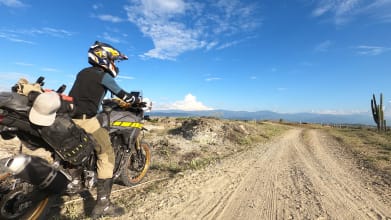

Betty was gone for a ten-day business trip with a visit to her mother in Miami woven in. Her rebuke of the LatAm unresolved. I decided to take a four-day trip to Bozeman to visit my parents, my sister’s family, and Alex, my son. The 450-mile round trip would also allow me to test run the Tiger under fully-loaded conditions I thought would be similar to the LatAm — some highway riding, some improved dirt road, and some two-track. My goal was to log at least 1,000 miles on the new Tiger before shipping it south.
Riding a new bike out of the crate often uncovers things that were missed at the factory. Small defects in workmanship or loose fasteners. I also knew I needed more familiarity with the bike, its handling, and riding fully loaded on pavement and off-road.
With Betty gone and my work obligations under control, I spent a couple of days in the garage dismantling and reassembling the major components of the Tiger. A new bike feels great out of the crate, but the factories miss details that matter. Screws are improperly torqued or missing completely. Insufficient grease on bearing surfaces. I always find something.
Digging into the new Triumph revealed its British engineering, precision-machined components, and stainless-steel allen screw fasteners. The white tank was surrounded by a matching factory-installed crash bar, the one flimsy thing on the bike.
I installed aftermarket upgrades along the way. A high front fender, luggage rack, firm heated seat, and wiring for my phone charger, GPS, and heated jacket. I routed all of it from the auxiliary fuse under the seat, through the airbox compartment, under the tank, to the cockpit. This is work I wouldn’t trust to a shop mechanic. I didn’t like the slick Pirelli tires that came stock on the bike, street-oriented. The tires I chose were the Heidenau Rangers — I had ridden them on the 790 in Ecuador and liked their grip on slick surfaces.
The most important upgrade was the suspension. Manufacturers market these bikes as off-road capable. In reality, they know that 90% will never see a dirt road, consigned to be commuters. I invested in Touratech’s front-and-rear aftermarket suspension setup for my fully loaded bike, matched to my riding style and weight. I spent the better part of a day dismantling and rebuilding the bike’s front forks, installing new components and oil that would transform the handling from a street-oriented bike to one that could chew through rough roads. The rear shock was a much easier swap.
I mounted the luggage panniers to test the fit. They wanted to stick out like a toddler’s legs on a tricycle. I fabricated aluminum supports and bolted them to the subframe. The last thing I wanted on rough roads was bouncing luggage.
Sturdy black crash bars, aluminum hand guards, and protective tank stickers rounded out the build.
I mounted a mid-sized tank bag behind the bars, one that could be easily removed for security. In it, I kept items I’d want to access without dismounting — a small multi-tool with a knife, an allen wrench set for fast adjustments, an extra USB cord, a copy of the bike registration, and an insurance card. Almond butter packets and energy chews for the day. A small hydration bladder in the bottom compartment I could access while riding.
I laid everything out on my workbench — sleeping pad, tent, camp chair, JetBoil, tools, tire repair kit, spare parts, and first aid kit. Then I organized it into packing cubes, being careful to wrap sharp, hard items with softer goods to prevent rubbing and degradation on rough roads. I loaded the dry bags inserts for panniers with the heaviest items first, keeping the center of gravity low and balanced. I dedicated the smaller pouch on each pannier to items I’d need for quick access — tool roll and repair kit on one side, tire kit, sunscreen, wipes, and toilet paper on the other. I bought a waterproof document bag to keep in my top bag; it would hold the Triumph’s title, registration, and the temporary import permits for each country. This was a first cut, a dry run. A way to see what was missing before it mattered.
I loaded the bike and adjusted the front and rear suspension sag.
* * *
The weather forecast was for precipitation, lows in the 20’s, highs in the upper-30’s. Mix of rain and snow.
I created a route that would take me from Jackson to Flagg Ranch at the border of Yellowstone, then cut west on a US Forest Service road past Grassy Lake to Idaho. From there, remote USFS roads and two-track ATV trails north, to West Yellowstone, where I would rejoin the highway down the Gallatin River, past Big Sky, into Bozeman. A combination of two-lane highway, rough dirt roads, two-track trails, and twisty canyon highway. I spent three hours trying to load a GPX file from the Gaia app to my Garmin Zumo. The overly complex software was also buggy. An hour on the phone with tech support revealed outdated firmware on the brand-new GPS unit and an underlying flaw in the file system.
I loaded the bike as if I were off for the multi-month trip we were planning. Tools, tire repair kit, spare parts, camping gear, everything. Then I loaded my top pack with my work laptop, clothes, and overnight kit. The bike felt heavy, tippy.
I opened the garage door and fired the Triumph up. Betty was gone. I pulled out quietly, no particular reason to, just the instinct to leave without disturbing anything. The southern rock playlist drew me onto Highway 191 toward white lines that go forever.
I rode past Jackson Lake, cold, no boats on the water this late in the season, reminding me of the summer parties on the lake with Betty and friends. I arrived at the Flagg Ranch convenience store at 1:30. I parked in front of the grey-painted store and went inside to warm up. The Triumph looked small, sitting by itself in one of fifty empty RV spaces, each the size of a Greyhound bus.
The cafe was closed for the season, so I settled for what I could piece together in the c-store for lunch. A Red Bull, a bag of chips, and a microwave cup of soup. Before riding out, I pulled around to the Exxon behind the store to top off my tank.
The storm front had started to move in. It was a chilly fall day in the mountains, the grey of the sky contrasting with the few remaining bright yellow quaking aspen leaves.
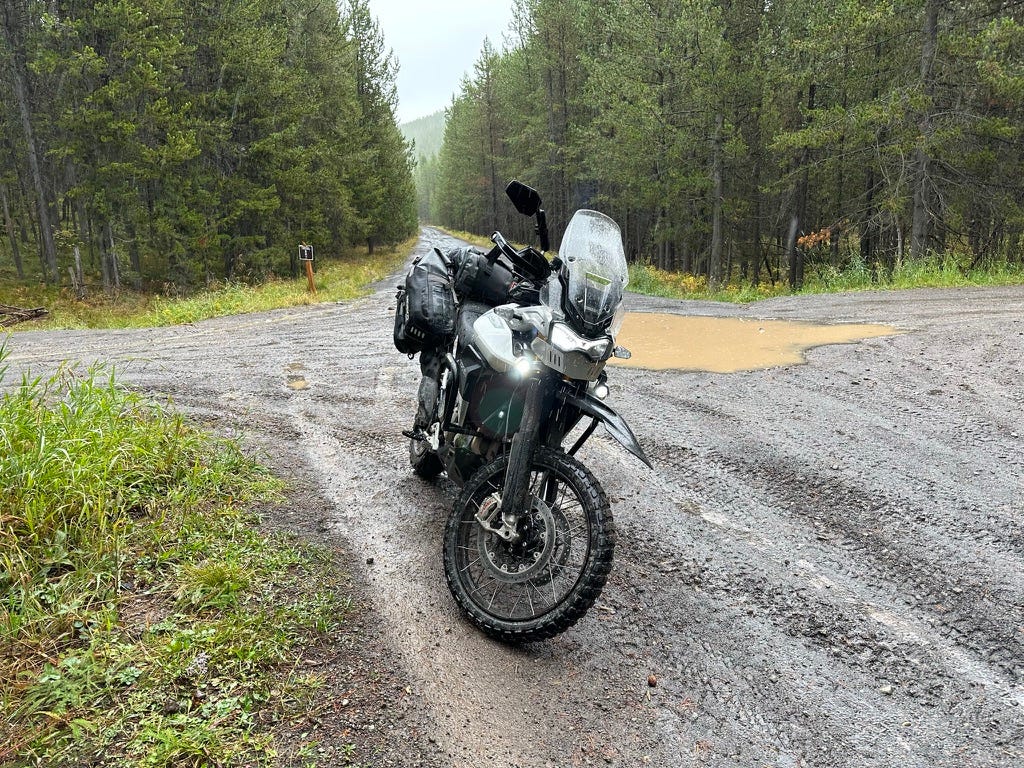
I rode west on the Grassy Lake road as it began to rain. I stopped, put on my Gore-Tex rain pants and heated jacket, and took in the wet, peaty smell of the forest. I was already wearing my Gore-Tex ski gloves. The road, which had been built in 1911 to transport materials from Aston, Idaho, for the construction of the Jackson Lake dam, had not been bladed since opening in May. The washboards and potholes jarred the bike as I rode the 30 miles in standing position, passing only two vehicles.
I turned north onto a secondary dirt road just after crossing the border. After about a mile, I spotted giant Grizzly scat in the middle of the road. I did a U-turn to check it out. The claw marks in the fresh mud were still visible. I felt watched and continued on, the hairs on my neck alert.
Ten miles before West Yellowstone, I followed my GPS to an ATV trail that disappeared into the forest. There was a well-traveled three-foot mound bulldozed at the start of the trail to keep non-ATV vehicles out. I hit the mound in third gear as I would on a dirt bike. The rear of the bike rebounded off the top, sending me fully onto the front wheel. The rear of the laden bike swapped back and forth three or four times, tossing my feet off the pegs and slamming me to the seat. The Tiger settled as I eased on the throttle and stayed off the brakes. Manners.
The cold, wet pavement down the Gallatin River was slick. It felt foreign. I decided to slow my pace and make it to Bozeman in one piece.
I spent a couple of nights at my parents’ place helping my mom take care of overdue maintenance on their house. My dad’s decline was more pronounced this time. Lost thoughts in the middle of sentences, and the slow shuffling of his feet behind his walker. His brain had been scrambled when his head hit the concrete from a fall in his garage in 2019. A month after, he retired from ranching. The traumatic brain injury landed him in a neuro ICU for three weeks. His strong intellect was there with no way to get out. I missed being able to discuss philosophy, art and politics with him.

* * *
The weather was getting colder and the forecast was for snow in West Yellowstone. I decided to head back to beat the weather, retracing the route I had ridden to Bozeman.
The snow level had dropped significantly. By the time I got to West Yellowstone, four inches of wet snow had accumulated on the sides of the road. The roads were a combination of wet and slush, moving toward frozen. I could take the fast way home on the highway through Island Park and risk the traffic on freezing roads, or I could take the backroads I had ridden up and risk getting stuck solo in the woods in six inches of snow. I felt safer with the latter. I’d rather be self-reliant in the wilderness without worrying about big trucks or bad drivers pushing me off the road.
About ten miles south of West Yellowstone on the two-track, I stopped to down an energy bar and drink some water. I put my sidestand down and dismounted the bike. Before I could steady myself and the handlebars, the stand began to sink in the soft mud on the road. The bike tipped past a point where I could hold it up. It fell. The bike, with gear, weighed over 500 pounds. I grabbed the bar-end stuck in the mud with my left hand, and the subframe by my luggage with the right, squatted and tried to deadlift the machine to its wheels. The tires on the other side of the bike slid in the soft mud, preventing it from tilting up. My boots found no traction and I slipped to my knees. I tried again, this time leaning into the bike backward and leg pressing. It slid further into the mud.
The snow was now coming down at a rate of an inch an hour. I was breathing hard and my base layer was wet with sweat. The thought crossed my mind that I could be stranded out here without help. Not the best conditions to try out my tent and three-season sleeping bag. The chances of anyone coming down this trail today were slim.
I decided to dismount my gear as the bike lay on its side. This would relieve the bike of at least 75 pounds positioned up high. I tried the deadlift again and the bike slid. I needed to stop the wheels from sliding, so I found a large stick on the side of the road to dig tire-width trenches under each wheel, hoping they would find purchase as I tried to angle the Tiger back upright.
I was sweating under my layers. I removed my GoreTex riding jacket. I grabbed the bike again. It felt lighter as I rocked it up on the crash bars, wheels dipping into the small trenches. After three tries I was able to get the bike to a 45-degree position, my feet slipping but less than before. I held my breath and repositioned my feet in the mud. One last effort to get the bike to its wheels.
Now the only problem was that I could not let go of the bike. If I tried the sidestand it would surely sink again. I searched for anything within arm’s reach I could put under the stand. The stick. But it was on the opposite side of the bike. I inched my way around the bike, stepping over my sprawled luggage, being careful not to let the balanced bike tip. Balancing the bike with my left hand, I extended my right leg enough to hook the stick and inch it close enough to pick it up. I placed it under the sidestand. The unsteady Tiger teetered as I carefully remounted my panniers and top pack.
The steady snow was now accumulating on the road surface. My hair was wet and getting cold. I redressed myself, ate a couple of energy chews, and headed out. By the time I was off the two-track and on the forest roads there were four inches of untracked snow. The ABS and traction control earned their keep. So did the Heidenau tires.
I was cold and wet with another 60 miles before reaching Flagg Ranch, where I could warm myself. The heated jacket, seat, and handgrips worked but could not warm me enough to prevent shivering.
I knew that I had chosen the right companion for the LatAm.
* * *
I reached Flagg Ranch with burning cold fingers and cold to the core. I found a chair in the closed cafe and warmed myself with coffee and another microwave soup. The hour I spent there allowed the snow to stop and the clouds to begin lifting. On this side of the mountains, the pavement was clear of snow and cars. The crosswind blowing off the white caps of Jackson Lake penetrated the smallest of openings in my riding gear.
Riding into the driveway, the house was dark. I pulled close enough to the keypad on the garage door to enter the code without dismounting my bike. I pulled into the garage and shut the muddy Triumph off. I stripped my dirty boots and riding gear in the garage and grabbed my laptop, night kit, and dirty clothes from my top duffel. Everything else stayed.
The house was dark and quiet. Betty would not return for several days. It felt empty, and I was alone.
Excellent writing. Felt the cold, saw the road. The details of the bike, which the author has turned into a living being, the "Tiger." Felt the anguish at being stuck in such dangerous circumstances. Alone and having to trust your strength and knowledge in such a desolate place.