

It had been a long day. Too long.
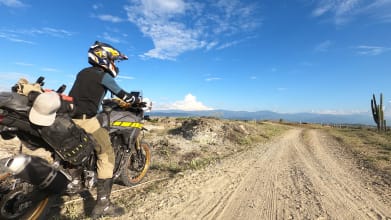
Fourteen hours earlier we left Cochabamba under a hard, colorless sun. Now it is fully dark.
The quiet of the tires hitting the Carretera 5 pavement after 190 miles of dirt takes the edge off. I short shift the gears as my focus quickly narrows to whatever my headlights can reach. The tires now hum. Oncoming truck lights blind my dry, gritty, exhausted eyes. The lights of Sucre peek around the switchbacks in the valley below.
For the first time all day, my shoulders drop.
We have broken every rule. No riding at night. No passing gas. Always stay together. Rules we follow not for discipline, but for survival. By the time the city comes into full view, my hunger and thirst have stripped everything down to a single goal: reach the hotel and stop moving.
The hotel was Tucker’s find. A decent place, by Bolivian standards, he said. Old colonial center. I have the route locked in my GPS as always — entered earlier, during a brief stop.
As we enter the scantily lit city, the road widens into a four-lane intersection. I move to the right lane, follow the blue line on my screen toward downtown. Tucker pulls alongside me in the left lane and stops, left signal blinking.
Our intercoms died eight hours ago. I flip my visor open and yell, “We should be turning right here.”
No response. Just the Triumph’s warm idle.
“Where are you taking us?” I yell again.
“To the hotel,” he yells back.
“This isn’t the way.”
Nothing. I see him flip his visor back down. The light turns green.
Against what I knew, I follow him. Stay together, especially at night.
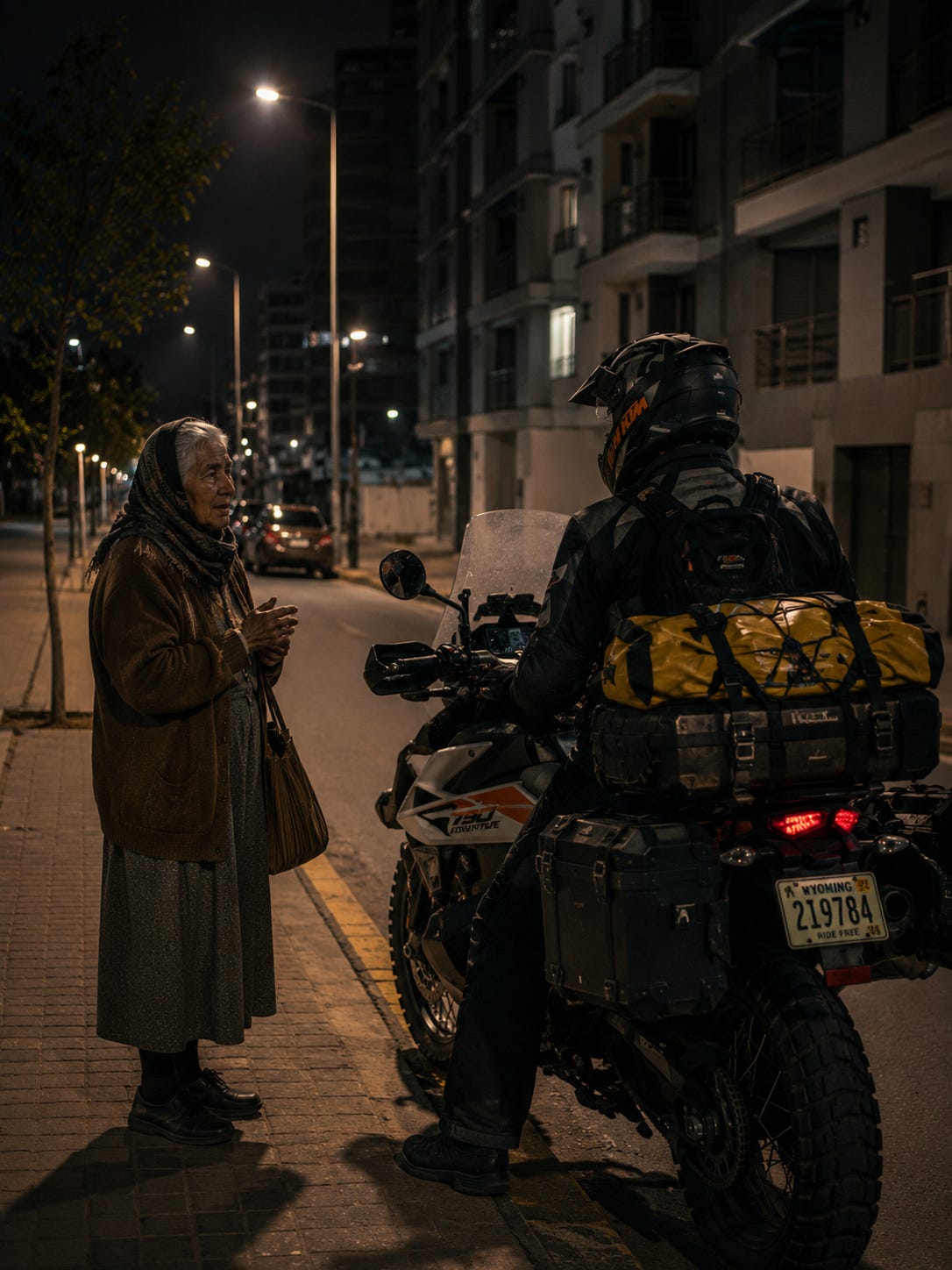
The streets narrow. The lights thin. We turn up a steep street. Then again. Soon we are riding through a residential neighborhood with no streetlights at all. A hunched elderly woman is walking alone on the sidewalk. Tucker spots her and pulls over.
I pull alongside him and lift my visor, turn the motor off. “We’re not in the right place,” I say. “I have the hotel locked. We should be downtown.”
He rides up next to her, lifts his visor. “Disculpe,” he asked, “¿podría indicarnos cómo llegar al hotel de Su Merced?” (where is the hotel de Su Merced?)
I see her shake her head.
I hear him say, “This is the right address, dammit!”
“There’s no way she knows where that hotel is,” I say. “There are no hotels here. Let’s go. I’ve got it in my GPS.”
A pause.
Then, flat and final: “Fuck off! Shut the fuck up!”
Inside my silent helmet, the tinnitus rings. My cotton mouth tastes sour.
I have no reply.
I start my bike, make a slow U-turn, and follow the blue line on my screen back across the city. At the next intersection, a headlight flickers in my mirror. Tucker follows.
The hotel he had picked is sold out. So is the next. Friday night in Sucre.
It takes another 30 minutes before we find a place with a vacancy. Atop a steep hill overlooking the city.
Arriving, I pull in close to the reception area and dismount. I unstrap my top duffel, grab my passport, and check in efficiently. I buy two bottles of water at the front desk and slam one on the spot.
I head past Tucker in the gravel parking area while he deals with his gear.
In my room, I down two almond butter packets for dinner and slam most of my second water bottle. The cool shower water hits my dirt-drenched skin and barely cuts through the grime. There is no shampoo; I use bar soap to scrub my hair and scalp. I know the film left behind will remind me tomorrow of the fucked-up evening I’ve just experienced.
Lying in the dark, listening to the city dogs barking through the open window, I understand something I wouldn’t fully accept for many miles to come.
It wasn’t the insult. The crack had been there for thousands of miles — his lateness, his detours, and my grip on the agenda.
It is the silence afterward — and how much lighter it feels.
I was already gone, and so was he.
© 2026 Major Dude Media LLC. All rights reserved.
That was the day. Way harder than any marathon I’ve run or mountain I’ve climbed. At least 8 of the 14 hours of riding knowing no Global Rescue or Garmin/InReach is going to make any difference.
I’m looking forward to reading more. You are on a super important topic.
I like how you jump right Into it. I’d get caught up in everything that led up to that moment of exhaustion.
You cut the the chase. It takes a very real moment to break things open lay it out there. I think that’s really what we are looking for. True moments of connection.
That leads me to a small correction to make and perhaps a point you might agree with. Our intercoms (Cardo’s) batteries died after 8 or 9 hours. Right as it was getting dark. Just after we were ½ joking of riding through Chupacabra land as the rocks in the trail kept turning into nightengales or small owls or something in that weird dreamtime of dehydration/exhaustion/amazement/fear riding into the complete where the fuck are we?
So, our chitchat to take the edge off and ability to concur was gone as we rode into Sucre. We could only yell over our bikes at intersections. Our technology, both it’s aid and it’s ability to serve as a security blanket was gone. Coupled with our exhaustion, that led to that moment. My point might be that our ability to be in constant easy communication often results in us never really communicating well. Never really risking to cut to the chase. It’s only when I know I’m about to lose connection that I say it: Tell me in as few words as possible what you want to say.
Shaun, I hope you know how much I treasure our friendship. I do think respect, true respect, is earned. And that’s a foundation to friendship. You have earned it many times to me but that day was a holy shit: Full Respect Dude. It doesn’t come easily. But it’s the Spanish Real. The Spanish word Real can translate into both Royal and Real in English. It is both.