
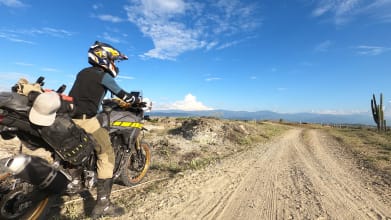

The hotel breakfast is the best we’ve had so far. Fresh pastries, fresh fruit, fried eggs, and orange juice. The coffee is strong and higher quality than we’ve had since leaving Bogotá.
“Anyone hear anything from Veronica?” Evan asks.
“Nothing on WhatsApp,” Tucker says.
“I’ll give her a call,” I say.
“Groundhog day,” Aaron says.
“I know, this is complete bullshit; we should have never trusted these people,” Evan says.
This time, I don’t let it go. “Look, nothing happens unless we put trust in people to get their jobs done. Veronica had great reviews online and has been upfront with us the whole time.”
“Yeah, but this is BS,” Evan retorts.
“I’m frustrated too, but at least we’re riding,” I argue. “We will get our bikes eventually.”
“I’m sure we will get it resolved at some point,” Aaron says, trying to diffuse the tension.
Breakfast ends, and we head to our rooms to get ready for the day.
I check my messages again — nothing from Blaine. Aggravated by the exchange with Evan, I text: “Blaine, I’m concerned and would like to talk today to see where we are and discuss what needs to happen.” I’m now fully preoccupied by the situation back home.
Before leaving the room, I call Betty as promised. The call forwards to voicemail, and I feel more alone. I leave a short message and head out to meet my friends for some exploring on foot before hitting the road again.
* * *
We stumble into a pop-up BMW motorcycle promotional event a few blocks from our hotel. The facility is in a colonial building restored into a community event center. When we arrive, young women are putting up promotional banners and product displays, getting ready for an event. Brand-new machines alongside perfectly preserved vintage bikes, on stands all around. A makeshift barista offers us espresso drinks; I take her up on the offer and ask for a double.
Aaron and I run across a man who seems to be in charge of the event. “What’s going on here?” Aaron asks, assuming the man speaks English. He does.
“We are launching the new GS 1,300 in South America today here,” he replies.
“Very cool,” I reply.
“Stick around; we will be serving lunch in a couple of hours, and a few celebrities will be stopping by,” the man replies.
Looking around, I can tell that the event hasn’t opened yet, and we are probably where we shouldn’t be. This doesn’t stop us from checking out the vintage bikes while the staff sets up.
Aaron approaches a woman organizing a rack with BMW-branded riding gear. “Habla Inglés?” he asks.
“Yes, a little,” she replies perfectly.
“Are you selling riding boots here today?” he asks.
“We have a few pairs. What size do you need?” she asks.
“I’m a 42 or 44,” he replies.
“I’m a 42,” I interject.
She disappears outside to the sprinter van that carries the goods for the event and returns with two boxes. “Here are the 42’s,” she hands a box to me. “And some 44’s,” and hands the other box to Aaron.
There is no place to sit, so we remove our cheap hiking boots in the middle of the room and try on the BMW touring boots. Mine fit perfectly, and immediately my feet, ankles, and shins feel more secure.
“How are yours?” I ask Aaron.
“Slightly big. Can I try yours?”
“Sure thing.” I pull one boot off and hand it to him.
I can tell it’s hard to pull on. “Too small,” he says and hands it back.
The BMW-branded leather boots are relatively inexpensive, the equivalent of $250 US dollars, and well worth it. The boots aren’t as burly as the ones strapped to my bike sitting in Miami, but I’m relieved to finally have some protection for my feet, ankles, and shins. We pay and head back to the hotel to pack up.
I use the laces of my cheap hiking boots to secure them to the outside of my duffel bag, loose and sloppy, but it will work for now. I hope to donate them to someone needy along the road later in the day.
* * *
Our ride today is a short 62 miles on rural, mostly paved roads to a lodge on a large lake near Norcasia. About halfway, while riding in the lead, I pass an old, hunched man walking barefoot with a cane on the side of the road. It takes me about 100 meters to register the scene. I find a spot wide enough to turn around, and manage a three-point turn without falling off into the jungle on either side. The others ride past me as I ride slowly back to the old man.
He is startled when I approach, stop, and shut my bike down. As I approach, I notice his leathery skin. His worn, sweaty tank top is torn and filthy. His jeans are worn through at the knees and ragged around the cuffs. He stands with most of his weight on his left foot. I can’t imagine where he is coming from, or where he might be headed.
“Hola,” I say, smiling, making eye contact. “Buenos días.”
“Hola,” he quietly replies with a look of confusion on his face.
I dismount and begin to untie the boots from my duffel. “¿Gusta un par de botas? (do you like a pair of boots?)” I ask in broken, incorrect Spanish.
He now looks more confused. I approach with the boots. “Estas para ti (these are for you),” again in poor Spanish.
I hand the boots to him. He smiles slightly but says nothing. I smile back and nod as if we somehow knew each other.
I remount my bike, start it, make another three-point turn on the wet road, and return to the others who are waiting where I passed them earlier.
* * *
We arrive in the town of Norcasia. This town of 6,400 people is known for its eco-tourism and the nearby Amani reservoir. There, we will take a boat to an eco-lodge made up of treehouses that Tucker found in his research. We park on the busy, colorful square. Aaron and I take refuge from the heat in a nearby cafe where we order cold sodas while Evan looks for a place to change some dollars.
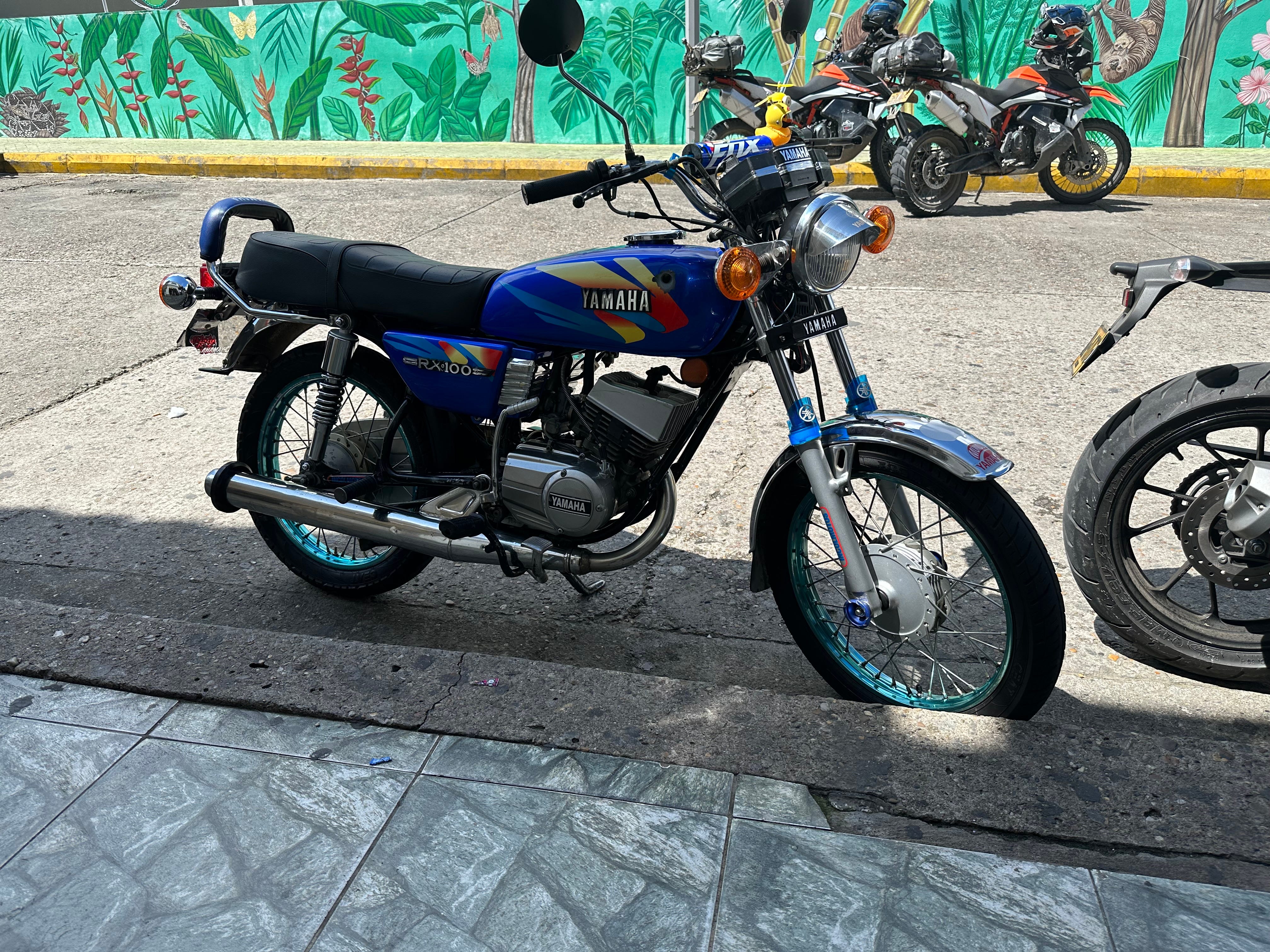
“Check out the motorcycles here, so clean,” Aaron points out.
I look around at the bikes parked in front of the cafe and those passing by — nearly all of them are in clean condition. This contrasts with the thousands of scooters and small motorcycles we’ve already seen in Colombia that are purely utilitarian. Here, they seem to mean more to their riders.
“Very cool, check out the customization. The LED lights,” I reply.
Meanwhile, Tucker is on a call with the hotel to get further instructions on how to get there.
While we wait, I decide to send a message to Blaine to see if I can clear my mind of the annoyance I am feeling.
My short note: “Burn rate? Runway? I still need answers!”
I delete the note before sending it.
Instead, I remember I forgot to call Veronica. I shoot her another message: “Any update on our motos? We are really getting concerned.” I don’t expect an immediate reply.
Tucker rejoins Aaron and me on the sidewalk with a cold beer.
“They want us to leave our bikes in a parking facility on the edge of town,” he tells us. “We are supposed to take taxis from there down to the lake where a boat will meet us for the ride across to the lodge.”
The paid parking site is nothing more than a partially covered dirt lot behind a house on the highway that leads out of town. The rickety gate is open when we arrive. The owner comes out to greet us immediately. He tells us it will be 15,000 pesos each (about $5) for 24 hours of parking. He directs us to the back of the lot, where several cars are parked, and tells us to park side by side along a fence shared with farm animals on the other side. Pushing my bike the 25 feet across the lot unleashes a stream of sweat down my face.
“This place doesn’t look too secure,” Evan announces. Nobody responds as we start unlashing our gear.
“¿Cuándo cerrarás el portón con llave? (When will you lock the gate?)” Tucker asks the owner.
“Cuando sales del trabajo,” the owner responds.
“He says he will lock it when we leave.”
“I suggest taking anything you can’t live without,” I say.
We park our motorcycles and secure items that would be easy to steal before calling two tuk-tuk cabs to take us to the boat launch. The three-wheeled taxis feel unstable as we descend about a mile down a very steep, one-lane paved road to a dock area. I can smell the acrid fumes of the burning, squeaking brakes from the taxi Tucker and I are riding in. I imagine how everything would be over if they failed and we flew off one of the switchbacks into the jungle. We nervously joke about the situation.
At the bottom of the hill, there is a small parking area where we unload. The tight area is buzzing with activity. A few ragged-looking men approach us immediately — one tries to sell us candy, and another couple, acting as porters, immediately grab our duffels, hoping to get paid. I let them, knowing that a small tip will mean a lot to them.
At the boat landing, a 30-foot livestock barge is docked and being loaded with cattle and pack animals for the crossing to a pasture somewhere on the 15-mile-long lake. The 20-foot fiberglass panga taking us to the lodge is also waiting. We meet our guide and he helps us load our duffels. I tip the porters a few pesos and board the boat.
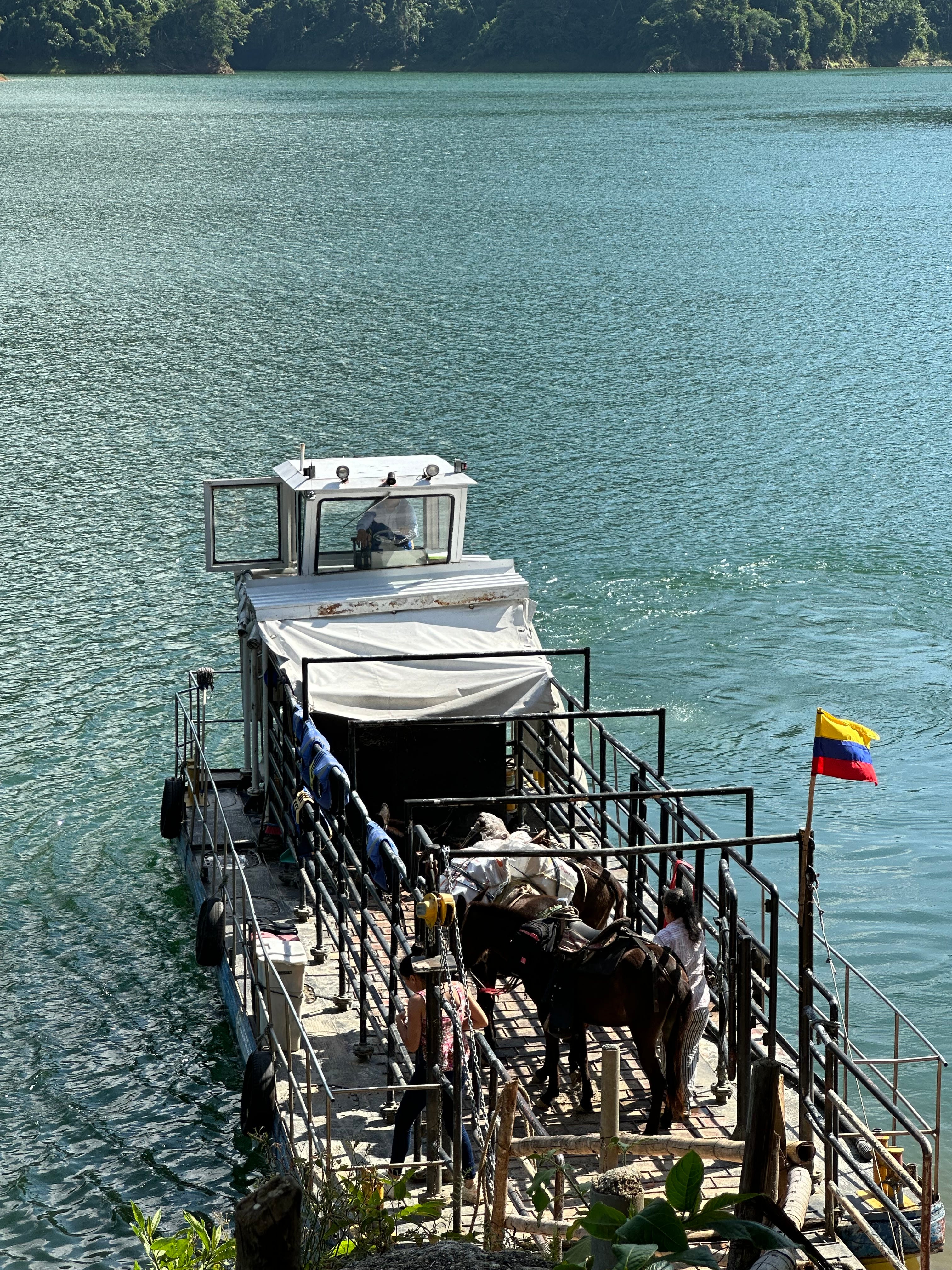
The open boat’s 15-horsepower two-stroke outboard putters away from the dock. The boat driver announces that the lodge isn’t ready to receive us and that he’ll take us on a lake tour. It’s only 3:30 in the afternoon and we are up for exploring, so nobody protests the delay. At this point I just want to get away from the stench of fresh cow and horse manure permeating the dead air.
The panga takes us a few miles up and across the lake. The steep jungle-covered hillsides fall steeply into the lake. High up I can see where the rainforest has been cleared for cattle grazing — not massive clear cuts, but big enough to scar the terrain. Tucker reaches into his pack and pulls out a box of Caldas rum he had stowed. Still cool, not yet warm, but no ice cubes here.
“Dude, what an awesome call!” I exclaim.
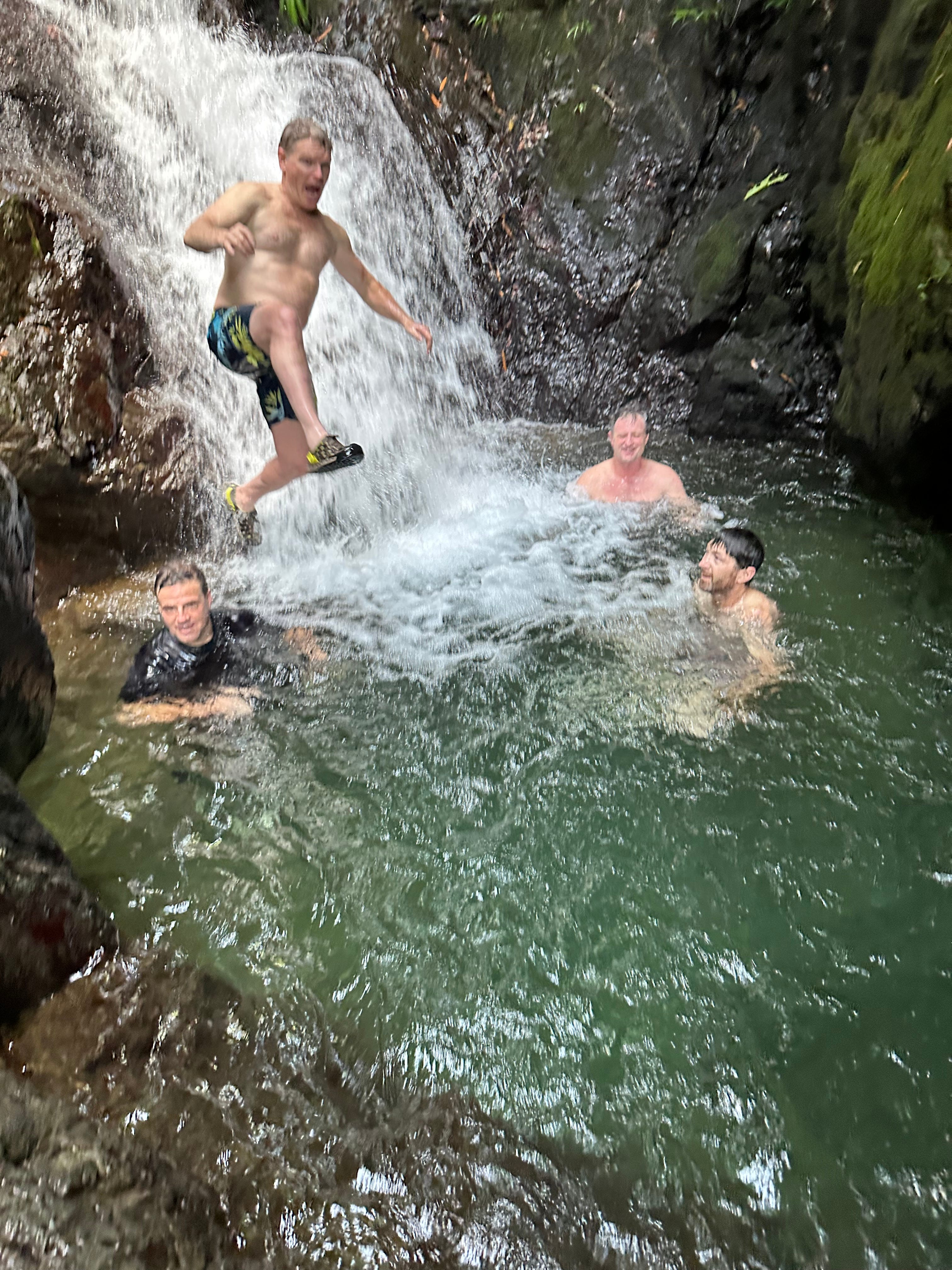
The boat driver hands us a knife to cut the corner of the box off so we can access the rum. We take turns pouring it straight into our mouths and pass it around before cracking cold beers. We eventually slide into a cove where a stream lands in the lake after a waterfall about ten feet high. “We will stop here for you to swim,” the boat driver announces.
We all reach for our luggage and begin digging for our swimsuits while the driver ties the boat to a tree on the shore. We disembark one by one, slowly and carefully from the bow, making sure not to fall in from the tipping. The driver leads us up the large boulders along the stream to another waterfall a few hundred feet upstream. The rocks are prickly on the bottom of my feet.
“It looks shallow,” Aaron says.
“Not sure I would dive in here,” Evan agrees.
Tucker makes the first move and jumps into the pool. The rest of us follow. The water is cool, not cold. We take turns climbing up the waterfall and jumping in. I’ve forgotten about the bikes, the road, Veronica, Blaine, Betty. The water, the beers, the jungle, the mindless fun banter. I finally feel like I’m away.
Around 5:00 the boat takes us to a boulder that serves as a dock directly across the lake from the harbor we departed from earlier. There we are greeted by the woman who operates the lodge, which sits about 300 feet above the lake. Evan, Aaron, and I unload our duffels and start hiking up the steep, muddy jungle trail, still in our flip-flops and board shorts. Tucker has decided to stay behind to try his hand at fishing from the shore.
About 50 meters up the trail, the hostess says something in broken English that none of us understand. Evan asks her to repeat.
“Watch for snakes,” she says. “They are very poisonous.”
I stop dead in my tracks and take notice of the rainforest floor thick with snake habitat. It makes me itch. “I’m stopping here to put my boots on,” I say.
“Me too,” Aaron says.
All three of us find boulders to sit on while we unpack our boots and put them on for protection up the remainder of the trail. We trudge the remainder of the steep, switchbacking trail in our board shorts and riding boots.
The treehouse “lodge” turns out to be one of those places that sounds too good to be true in the guidebook. It was. The three treehouses are roughly constructed on stilts, with corrugated metal roofs. Evidence of continuing construction is all around. Sewer pipes run next to water lines on the ground to an above-ground septic I can see propped up on rocks about 50 meters down the steep hillside. One treehouse has a queen bed and a single; the other, down the hill, has a full-sized bed but limited electricity for charging phones. The third appears to be occupied by the property’s owners and workers.
We throw our things down and sit on the balcony of the highest treehouse where we find cold beers in a mini-bar on the deck. We laugh about the adventure of getting here and the operation’s disorganization while we wait for Tucker to return.
I see Tucker coming up the trail from below and yell down, “How many did you catch?”
“Nada,” he replies. “The stick and string they gave me didn’t really work for fishing; I’ll bring my own gear next time.”
“No fresh fish for dinner tonight,” Aaron announces with humor.
We clean up and are served dinner on the deck.
After dinner, we play another round of cards. This time Aaron pulls out a win.
We finish the evening with a round of rock, paper, scissors to see which of us has to make the trek down the hill in the dark to the lower treehouse for the night. I lose every toss. Tucker loans me his headlamp for the 50-yard walk down to my treehouse.
Lying in a sheetless bed, I can hear monkeys, birds, and other creatures in the jungle. There is no cell service here, and the wi-fi is too weak for a call to Betty. I send her a goodnight text and check in one more time with Blaine.
* * *
After a breakfast of partially burned eggs, we load up and head across the lake on the boat. The air is heavy, and the sky is dark. Rain feels inevitable. We retrieve our motorcycles at the parking shed — everything is intact, just as we left it the day before. As usual, Aaron and I are ready to ride before Evan and Tucker have their gear secured. I notice that my cell phone has connected to the network again, and I decide to check for messages from Veronica. No news.
No news from Blaine either. I decide to let it sit until I’m in a place where I can call him and talk.
Before leaving, I lead the group into town to top off our tanks and tires for the 61-mile ride to Pensilvania. We are starting to find our rhythm riding as a group and agree that if we have time, we will try for the hot springs at Terminal de Ruiz, 77 miles past Pensilvania. Tucker decides not to follow us to the gas station and takes his own route to another gas station; we end up burning another 15 minutes waiting for the group to come back together.
I feel my rear tire slip as I accelerate onto the two-lane highway, the surface already slick from the humidity in the air. I let off the pace.
The first raindrop hits my face shield about five minutes out of town. Then another. It isn’t long before sheets of rain begin to obscure our view of the road in front of us. Aaron, in the lead, decides to pull over to put on his rain poncho. I have one too, a cheap plastic version the guys bought for me in Bogotá. It’s too late; I’m soaked head to toe. I feel like I should be shivering, but I feel warmed by the rain and humidity.
We ride another five minutes slowly on the slick two-lane paved road. Aaron spots a row of houses along the road, one with a sign advertising fruit for sale. We pull in. A couple of younger, well-dressed men and an elderly woman sit in chairs on the front porch. A teenager leans against the wall while they talk. Two or three generations of the same family, all there.
Tucker asks the woman if we could join them under their veranda until the rain dies down. The three family members stand without saying a word, giving up their seats for four completely soaked strangers.
We sit and make quiet small talk with the family, Tucker translating. We learn these rainstorms are a near-daily occurrence in this part of Colombia and last about 30 to 60 minutes. Tucker asks about further down the road toward Pennsylvania. The three are confused, not recognizing the name of the place.
We offer to purchase fruit from the woman. She hands us some fresh bananas and papaya and, at first, refuses to let us pay. I reach into my pocket, grab the equivalent of $5 in pesos, and hand it to the younger man, who accepts it.
The rain slows, then stops. As we head out, I notice that my phone is no longer charging. I mess with the USB connector but nothing seems to work. My battery is already at 30% — it won’t last the rest of the day with navigation running. I turn off my maps and let the group know I won’t have navigation today. I’ll follow.
© 2026 Major Dude Media LLC. All rights reserved.