
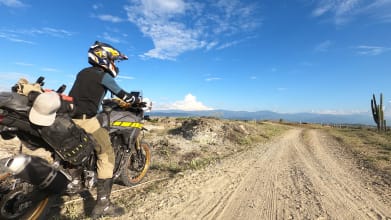

On day six, while we are stopped for lunch, Veronica finally messages with good news: our bikes are on their way to Bogotá. She reminds us we have to be there when they arrive. That’s why we didn’t ship them ahead ten days ago. She still only has an estimated arrival date, plus or minus 24 hours.
After spending the night at Terminales de Ruiz, we angle back toward Bogotá and spend one last night in a cool boutique hotel two hours out. Infinity pool and bungalows; we enjoy cold cocktails after checking in, which is already becoming a ritual. Expensive by Columbian standards, $150. The dated but nice rooms are quiet and allow me to get a solid night’s sleep. In the morning, I head to breakfast 30 minutes before the others arrive to have my coffee and check email.
Finally, an email from Blaine. “We have shuffled some payables and have reached out to slow-paying customers to collect cash.” Something they should have been doing all along. “We will make payroll, but barely.”
“I’ll be back on the 11th and will stop in Denver on my way home so that we can meet to talk about the future,” knowing that we won’t miss payroll lets me put the drama aside for now.
The others trickle in for breakfast and agree to meet at 9:00 to ride the hundred-mile leg to Bogotá. At 9:00 three of us are loaded and ready to roll. No Tucker.
“Let’s roll,” I suggest. “He knows where we are headed.”
“I agree,” says Evan. “This is bullshit.”
Before he can respond, Aaron spots Tucker coming up the hill to the parking area. “Here he comes.” It’s 9:20.
“I had to check my bill, and then Hannah called,” he at least acknowledges his tardiness.
I fume under my helmet but hop off anyway to help him get his gear strapped on. Aaron checks the tires. In ten minutes we ride out.
Within minutes of leaving the Villeta Boutique Hotel and Spa, we are on Highway 50, the main artery running between Medellín and Bogotá. The fast two-lane road becomes four lanes after 20 minutes, then climbs immediately with a series of banked hairpins weaving through the forest. Trucks belch black smoke as they struggle for oxygen up the 6,000-foot climb to the summit at 9,500 feet. They drive side by side, jockeying for position and blocking faster-moving cars and our motorcycles from passing. The whole thing feels like an unsanctioned race. Again, I over-grip the handlebars and can’t find a gear that fits the speed and tightness of the turns and traffic.
After crossing the summit, we drop 1,500 feet into the arid Sabana de Bogotá. The trucks now build downhill momentum, gain speed, and use both lanes without regard for smaller vehicles. Passing even the slow vehicles on the hairpins causes me to grip even harder. At least the riding of the past several days has rounded my rental KTM’s tires so I can hold a decent line on the pavement. Aaron and Evan are now out of my sight, and Tucker is somewhere behind me. I’m too nervous to look in my rearview long enough to find him.
The 50 enters Bogotá close to where we exited the city on the 55 a week earlier. Jorge’s shop is the destination on my phone; if I don’t reconnect with the others, I know I will find them there. “Aaron, do you copy?” I ping my intercom. “Tucker, do you copy?” I wait a few minutes before trying again, to no avail.
I find Aaron and Evan waiting on the side of the road after a stoplight. Tucker pulls in behind me. “That descent was crazy,” I say.
“I know, not safe,” Tucker says.
We arrive at Jorge’s office around 1:00; it’s hot and stuffy. We are anxious to gather our things and head to the hotel.
We have seven days before flying home, enough time to make it to Quito if everything goes smoothly at customs in the morning. There is a chance we will need to circle back to Bogotá if we don’t have time to make Quito. Before we leave Jorge’s office I ask if we can leave our bikes in his garage in case we return to Bogotá at the end of the week. He says he will check with the landlord to see if we can use an extra parking space next to his. Parking side by side we can fit all four bikes. “¿Cuánto?” I ask.
“One hundred dollars each,” he answers in English. It seems reasonable for three months of secure storage.
“We will let you know if we need the space before the end of the week.”
I feel better knowing the bikes will be secured for the two or three months they sit while we return home.
After dropping the rental bikes, we grab two taxis to an airport hotel called the Movich. Clean, comfortable, efficient — the local equivalent of a Marriott. We check in, shower, and meet in the bar for cocktails before dinner.
Our mood and conversation are light; we look forward to un-crating our own machines tomorrow. I reach out to Veronica, who says her people will pick us up at 7:45 A.M. to take us to the Aduana (customs) office, emphasizing 7:45 so we can be first in line at eight.
The air conditioning and wi-fi work well. I sleep easily.
****
On day six, while we are stopped for lunch, Veronica finally messages with good news: our bikes are on their way to Bogotá. She reminds us we have to be there when they arrive. That’s why we didn’t ship them ahead ten days ago. She still only has an estimated arrival date, plus or minus 24 hours.
After spending the night at Terminales de Ruiz, we angle back toward Bogotá and spend one last night in a cool boutique hotel two hours out. Infinity pool and bungalows; we enjoy cold cocktails after checking in, which is already becoming a ritual. Expensive by Columbian standards, $150. The dated but nice rooms are quiet and allow me to get a solid night’s sleep. In the morning, I head to breakfast 30 minutes before the others arrive to have my coffee and check email.
Finally, an email from Blaine. “We have shuffled some payables and have reached out to slow-paying customers to collect cash.” Something they should have been doing all along. “We will make payroll, but barely.”
“I’ll be back on the 11th and will stop in Denver on my way home so that we can meet to talk about the future,” knowing that we won’t miss payroll lets me put the drama aside for now.
The others trickle in for breakfast and agree to meet at 9:00 to ride the hundred-mile leg to Bogotá. At 9:00 three of us are loaded and ready to roll. No Tucker.
“Let’s roll,” I suggest. “He knows where we are headed.”
“I agree,” says Evan. “This is bullshit.”
Before he can respond, Aaron spots Tucker coming up the hill to the parking area. “Here he comes.” It’s 9:20.
“I had to check my bill, and then Hannah called,” he at least acknowledges his tardiness.
I fume under my helmet but hop off anyway to help him get his gear strapped on. Aaron checks the tires. In ten minutes we ride out.
Within minutes of leaving the Villeta Boutique Hotel and Spa, we are on Highway 50, the main artery running between Medellín and Bogotá. The fast two-lane road becomes four lanes after 20 minutes, then climbs immediately with a series of banked hairpins weaving through the forest. Trucks belch black smoke as they struggle for oxygen up the 6,000-foot climb to the summit at 9,500 feet. They drive side by side, jockeying for position and blocking faster-moving cars and our motorcycles from passing. The whole thing feels like an unsanctioned race. Again, I over-grip the handlebars and can’t find a gear that fits the speed and tightness of the turns and traffic.
After crossing the summit, we drop 1,500 feet into the arid Sabana de Bogotá. The trucks now build downhill momentum, gain speed, and use both lanes without regard for smaller vehicles. Passing even the slow vehicles on the hairpins causes me to grip even harder. At least the riding of the past several days has rounded my rental KTM’s tires so I can hold a decent line on the pavement. Aaron and Evan are now out of my sight, and Tucker is somewhere behind me. I’m too nervous to look in my rearview long enough to find him.
The 50 enters Bogotá close to where we exited the city on the 55 a week earlier. Jorge’s shop is the destination on my phone; if I don’t reconnect with the others, I know I will find them there. “Aaron, do you copy?” I ping my intercom. “Tucker, do you copy?” I wait a few minutes before trying again, to no avail.
I find Aaron and Evan waiting on the side of the road after a stoplight. Tucker pulls in behind me. “That descent was crazy,” I say.
“I know, not safe,” Tucker says.
We arrive at Jorge’s office around 1:00; it’s hot and stuffy. We are anxious to gather our things and head to the hotel.
We have seven days before flying home, enough time to make it to Quito if everything goes smoothly at customs in the morning. There is a chance we will need to circle back to Bogotá if we don’t have time to make Quito. Before we leave Jorge’s office I ask if we can leave our bikes in his garage in case we return to Bogotá at the end of the week. He says he will check with the landlord to see if we can use an extra parking space next to his. Parking side by side we can fit all four bikes. “¿Cuánto?” I ask.
“One hundred dollars each,” he answers in English. It seems reasonable for three months of secure storage.
“We will let you know if we need the space before the end of the week.”
I feel better knowing the bikes will be secured for the two or three months they sit while we return home.
After dropping the rental bikes, we grab two taxis to an airport hotel called the Movich. Clean, comfortable, efficient — the local equivalent of a Marriott. We check in, shower, and meet in the bar for cocktails before dinner.
Our mood and conversation are light; we look forward to un-crating our own machines tomorrow. I reach out to Veronica, who says her people will pick us up at 7:45 A.M. to take us to the Aduana (customs) office, emphasizing 7:45 so we can be first in line at eight.
The air conditioning and wi-fi work well. I sleep easily.
****
The next morning, the four of us eat breakfast together and head to the front of the hotel at 7:45, ready to catch a ride with Veronica’s employee. I’m the only one holding a helmet.
I text Veronica, “We are in front of the hotel; where are your people?”
She takes five minutes to respond. “They will be there shortly.”
“This is bullshit,” Evan says disdainfully.
“It is what it is,” Aaron calmly interjects.
At this point, we have no idea how long it will take to retrieve our motorcycles from the Aduana; we assume it will be done by lunchtime, but we have no real information to support that belief.
8:15 passes. At 8:30, a tired white minivan shows up and stops at the curb where we are all now seated. Tucker confirms he is with Veronica. He is. “Hola, I’m Carlos,” he says in Spanglish. “The person who will be taking you through the Aduana today.”
Then we learn the customs office is only five minutes away, directly across the street from where we waited. We could have walked faster if we’d known where to go. We show IDs at the guard shack, cross the yard, and enter the four-story building, where we go through a metal detector to a reception window. We present our passports and motorcycle paperwork, and the agent behind the window gives us badges.
We follow our representative upstairs to the Aduana processing office. The room is a 30-by-60-foot open area with several rows of chairs, most of them with something broken, at one end. Most of the 30 or so chairs in the waiting area are already occupied by freight forwarders and truckers picking up their shipments.
The air is hot and unmoving. Sweat. Old cologne. Sour cigarette smell.
Opposite the open area with the chairs, four rows of desks extend to the far end of the office. About a quarter of them are occupied by agents, all working quietly. A small nativity scene and fake Christmas tree sit at the end of the middle row of desks. It’s December 6. Nothing seems to move with urgency here.
We find four chairs, but not together, and sit. I look for a place to set my bulky helmet without letting the padding and chin strap drag on the filthy floor. Veronica’s rep approaches one of the nearby agents in the seating area. After a short, quiet exchange, he returns to let us know we need to wait and that we are now in the queue.
“How long will we be here?” Tucker asks in Spanish.
“I have no idea,” the rep replies. Then he leaves the office. We look at each other and comment sarcastically about how we’ve been abandoned. In about 30 minutes, Carlos returns and stands against the wall. Time drags while I check and respond to email on my iPhone, the weak cell signal making it painfully slow.
The Aduana agents call people up one at a time, reminding me of the driver’s license office back home, just slower. One every 15 or 20 minutes.
I walk over to where Tucker sits. “I just did the math and at this pace there is no way they will get to us before the office closes at 4:00.”
“Really?” he asks.
“Really,” I confirm. “It’s 10:15, and there are about 20 people in front of us. They are processing three or four an hour; that means they probably won’t get to us, especially with an hour lunch break. Talk to Carlos and get his take on the situation; I’ll text Veronica.”
Tucker talks to Carlos and urges him to ask if he can speed up our processing. He is polite and sheepish. He doesn’t seem to know how to apply pressure, and he doesn’t seem to have a rapport with any of the Aduana agents. He returns to tell Tucker that we are in the queue, and that nothing can be done.
Fifteen minutes later, three people arrive wearing riding gear. I approach them and introduce myself. “Where are you coming from?”
“We just flew in from Panama,” the youngest replies with a German accent.
“Are you from Germany?” Aaron asks.
“I am; the others are from the U.S.,” he responds. “We are not traveling together.”
“Are you working with Veronica’s company?” I ask.
“Ya, we are,” the German replies.
I can see they were escorted here by an older agent from Veronica’s company; he seems to know the agents and is assertive in how he approaches them and presents the papers from the three newcomers.
I learn that the three had just flown in that morning from Panama and their bikes were ready to be picked up. “I’m not sure we are going to make it through the queue today,” I tell the young German.
Noon comes and the room empties. The agents leave their desks. We decide to walk the ten minutes back to the hotel for lunch. At 1:00 we are back in the Aduana’s waiting area. The same people drift back in. The same waiting settles over the room.
Two. Three. Three-thirty.
Then, the German and two other Americans are called forward to one of the agents.
“Did you see that?” I ask Aaron.
“Yep,” he replies.
“What the fuck,” Evan pipes in.
I call Veronica. “Hey, your three clients who arrived at 11:00 are already being processed; we have been here since 8:45.”
“OK, I’ll see what’s going on,” she replies.
I see Carlos’s phone ring; he answers. Looks confused.
I receive a text from Veronica: “I’m sending someone else over to help.”
Ten minutes later, a different man appears. José. Older. Assured. He moves straight to an agent who is helping another customer and speaks as if he belongs there. The energy shifts; Carlos watches.
The three riders who just arrived wait for an hour, are processed in 45 minutes, and disappear down the stairs to retrieve their bikes. We wait. At this point I’m tired of holding my helmet, and even more tired of reading on my smartphone. I finish the last crossword.
Four o’clock arrives. We miss the window; our only company now is José and Carlos. Everyone else has been processed.
Tucker is called forward first. Then Aaron. Then Evan. I’m last at 4:45.
****
At 5:15 we leave the now-closed office and cross the yard to the Aduana warehouse. The light is thinning fast; the yard’s halogen lights snap to life. We are led up a 50-foot ramp to one of the high-bay doors of the warehouse. Inside I can hear forklifts revving around. Halogen lights beam down on cargo stacked 30 feet high in some places. We are instructed to stand at the edge of the entrance where there is a yellow rectangle painted on the concrete — twenty feet by fifteen. We stand silently, all too tired to converse.
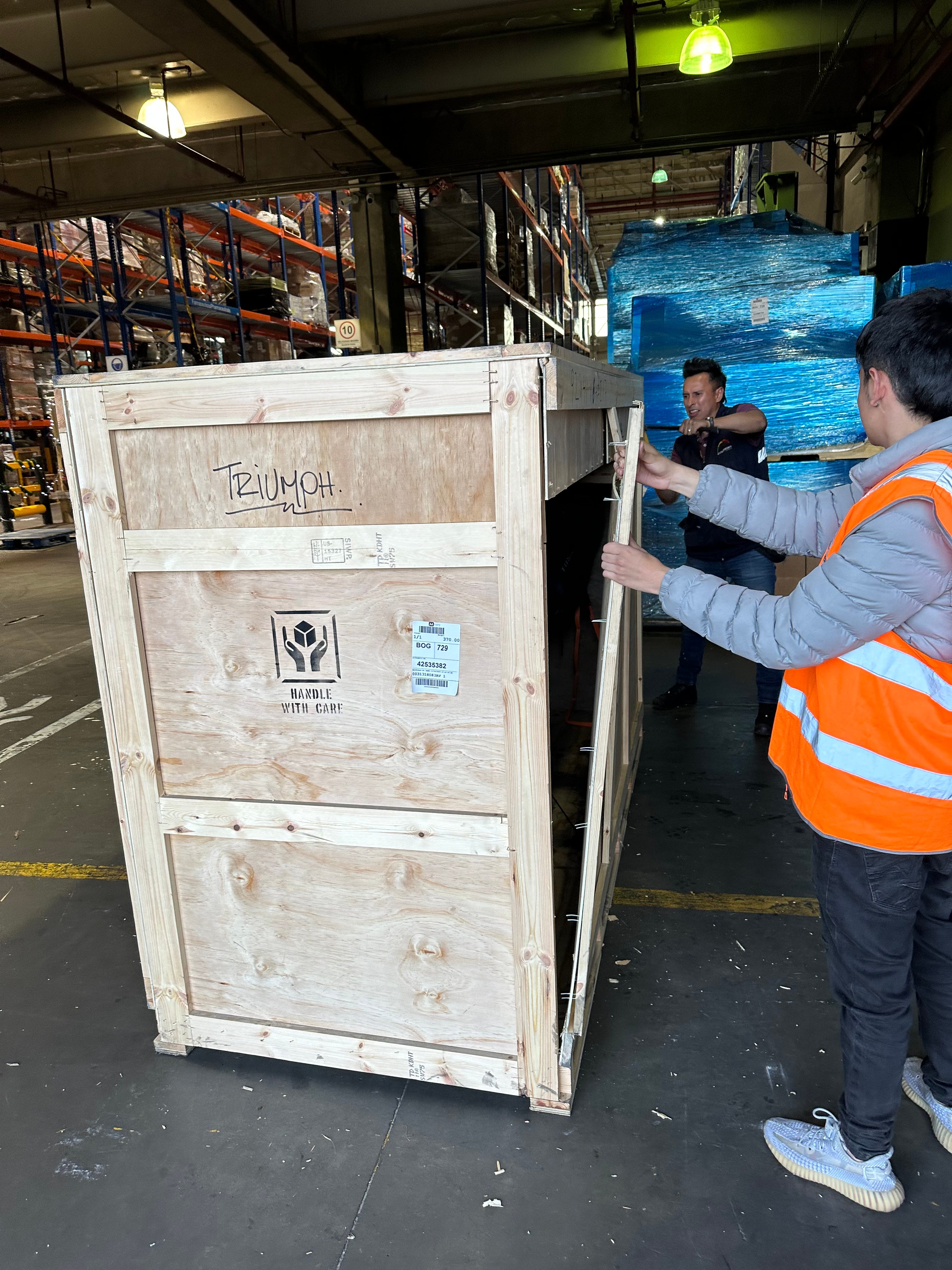
I hear a large forklift approach. It carries a wooden crate 12 feet long, five feet high, and four feet wide. It navigates around a row of stacked cargo smoothly and without slowing, and comes to a stop at the yellow square. The crate is lowered in front of us, and the forklift disappears into the massive warehouse. Evan’s Ducati.
Carlos hands us a crowbar and two claw hammers from the toolbox mounted on his run-down truck, which is parked at the bottom of the long loading ramp. Without the tools, we couldn’t dismantle and unpack the crates. I wear my riding gloves to protect my hands from sharp screws and splinters. We tear into the sturdy crate. Screws pop. Wood splits. It feels like opening Christmas presents as a kid. The Ducati sits there intact, strapped securely to the crate. Not a scratch on Evan’s new machine.
Next crate: Tucker’s 790. Then Aaron’s Ténéré. Then my Tiger.
By 6:30, the sun is gone, and it’s completely dark with the exception of the tired halogen lights barely illuminating the Aduana’s yard. The workers are closing up for the night, and I can feel their desire to have us gone. Nobody says anything to us, but it’s clear that they want us out of there as quickly as possible. Other than customs workers leaving for the day, activity has ceased.
Aaron rolls his bike to the bottom of the ramp, onto the edge of the dark parking lot while I’m still unlashing the last bits of packaging from the Tiger.
“My battery is dead,” I hear him say from the bottom of the ramp.
“Was it left on?” I ask.
“Yep,” he replies.
Carlos understands the exchange and grabs a pair of jumper cables from the old, rusty toolbox attached to the underside of the truck.
I roll my bike to the bottom of the ramp to be with the others. It’s darker here. I reach to turn my ignition on and feel a sinking feeling when I discover it was already fully turned to the right. I turn it counterclockwise to the off position, hoping that it was my mistake. Then back to the right. The display does not light up. The fuel pump does not hum. I press the starter. Nothing.
“My bike is dead too,” I announce. “They left the ignition on.”
Our bikes were left on in Miami, then sealed in their crates, sat for nearly two weeks, and slowly drained their batteries. No consequences for the incompetent people who loaded the bikes. Evan and Tucker’s bikes start without hesitation.
Tucker comes over to help. I hand him my phone with the light on so that I can see what I’m doing. Accessing the battery means removing the seat, which first requires removing the luggage strapped to the rack and subframe. It takes me a few minutes to remove the layers. Aaron is busy doing the same with his bike; Evan is helping.
I push my bike closer to the truck where Carlos runs the cables from the truck’s battery to the Tiger. I connect them, turn the ignition clockwise. The lights come on dimly, and I can hear the buzz of the fuel pump. I press the starter button. It fires up. I disconnect the cables and let the machine idle to charge the battery while I replace the seat and repack the luggage.
The Ténéré isn’t as cooperative. Aaron gets it started after a couple of tries, but the bike won’t idle without the cables attached. “I’m going to let it charge for a few minutes; you guys can take off,” he announces.
“I’ll stay here with Aaron if you guys want to head to the hotel,” I reply.
“I’ll stay,” Tucker says.
“Me too,” Evan falls in.
Aaron lets the bike idle for about ten minutes while we wait and talk about the day behind us. Eventually we roll to the gate in the dark. Aaron, Evan, Tucker roll through first, helmetless, showing the agent in the guard shack their paperwork. I’m last.
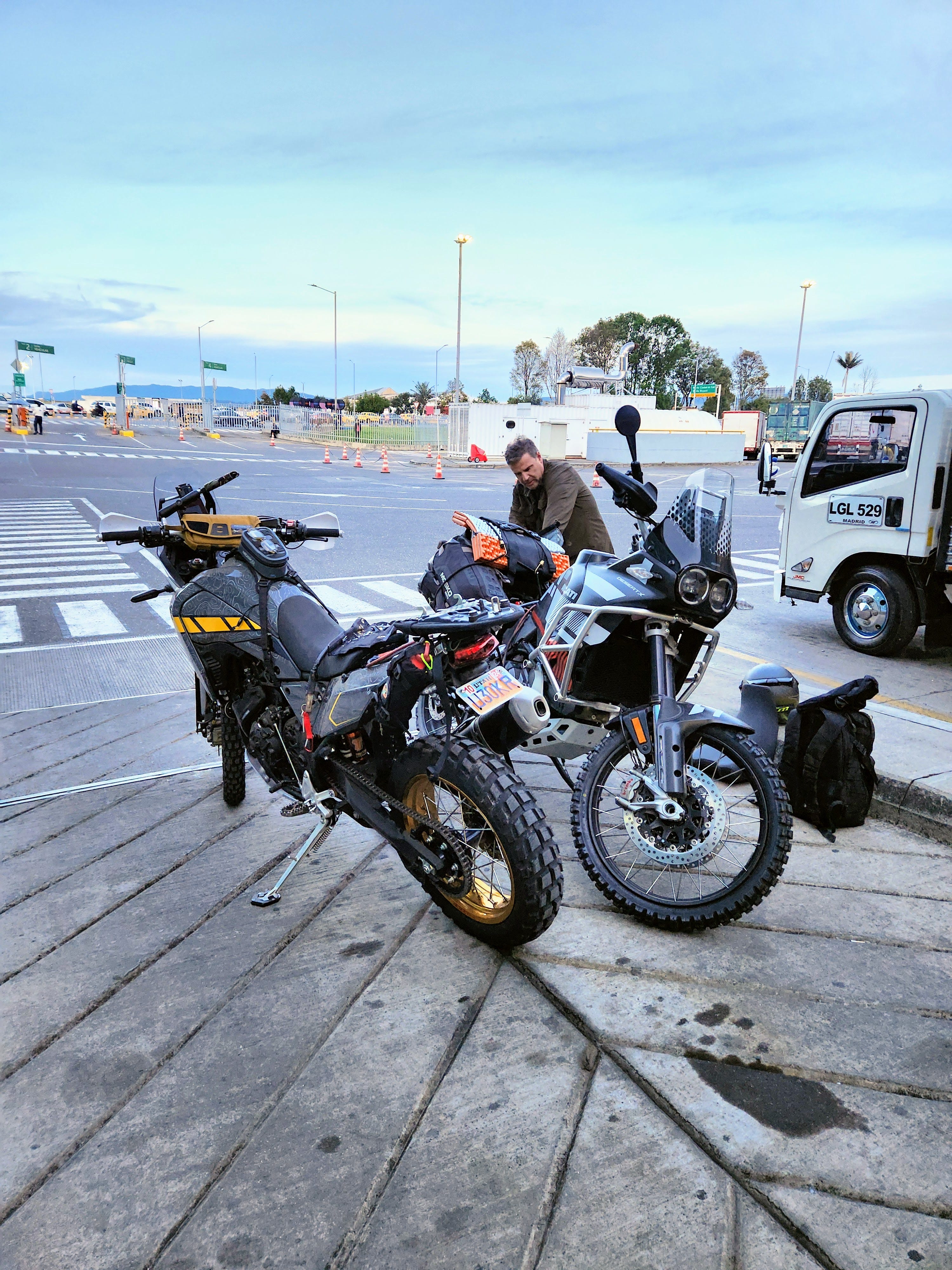
Outside is Bogotá traffic again — four lanes of slow-moving chaos headed away from the airport. I stop before entering the carretera and can see the hotel sign eight stories up on the other side, less than a hundred yards away. We need to cross, hit the airport turnaround about a quarter mile down, and come back up the opposite side. To do that, we need to get across four lanes of traffic.
They go. No helmets. Horns erupt immediately. Apparently, helmets are required in Bogotá, and for some reason, other drivers care if you aren’t wearing one.
I see a small opening between taxis and commit. I can see the turnaround and begin changing lanes to make the exit. I quickly make a lane change, then another, and can see that I still have 50 yards to get into the inside lane to make the exit, plenty of room.
© 2026 Major Dude Media LLC. All rights reserved.